

Say the word ambition, especially around women, and it brings up a complicated mix of emotions and beliefs.
If you’re not succeeding, you’re not ambitious enough. If you are succeeding, wanting a lot, and going for it, you’re too ambitious, and you get penalized or punished. It happens at work, at home, and in the communities we move through every day.
There are so many mixed messages about ambition and success coming at us from every direction. And it’s not just imposed from the outside.
For many women, those messages get internalized and shape the way we present ourselves and communicate about our work and personal lives. We start to police our own ambition, and we police each other’s ambition.
My guest today names the invisible norms around women’s ambitions, and calls out the ways that organizations perpetuate bias, even as they think they’re playing fair. Her work is extensively researched, tracing the roots of the tension around ambition, and also offers language and an opportunity for us to reclaim our ambitions together.
Stefanie O’Connell is an award-winning journalist and author of The Ambition Penalty: How Corporate Culture Tells Women to Step Up– and Then Pushes Them Down. Her work dismantles the myths keeping women from equitable pay, leadership and power — one data point at a time.
Listen to the full episode to hear:
- The material costs of what happens when women speak up, lean in, and get ambitious
- How implicit and gendered double standards around power keep women out of leadership
- Why encouraging ambition in girls doesn’t translate into celebrating ambition in women
- How people and organizations that believe they are meritocratic end up reinforcing the most bias
- Why we can’t self-optimize our way out of systemic inequality, and why we need collective action
- Six key elements for reframing burnout as an environmental problem, not a personal one
- Why we need to push back against framing women being pushed out of the work force as “empowerment” and challenge sexism in our everyday lives
Learn more about Stefanie O’Connell:
- Website
- Too Ambitious on Substack
- Instagram: @stefanieoconnell
- Threads: @stefanieoconnell
- TikTok: @stefaniemoconnell
- The Ambition Penalty
Learn more about Rebecca:
- rebeccaching.com
- Work With Rebecca
- The Unburdened Leader on Substack
- Sign up for the weekly Unburdened Leader Email
Resources:
- EP 155: Hidden Cost of Caretaking at Work: Nilofer Merchant on Invisible Norms Limiting Your Leadership
- Stop Punishing Women for Being Ambitious | Bloomberg
- Maslach, Christina. (1998). A Multidimensional Theory of Burnout. 10.1093/oso/9780198522799.003.0004.
- My Mother’s Daughter: Finding Myself in My Family’s Fractured Past, Tracy Clark-Flory
- Ragtime (2025 Broadway Cast Recording)
- Mad Men
Favorite Moments
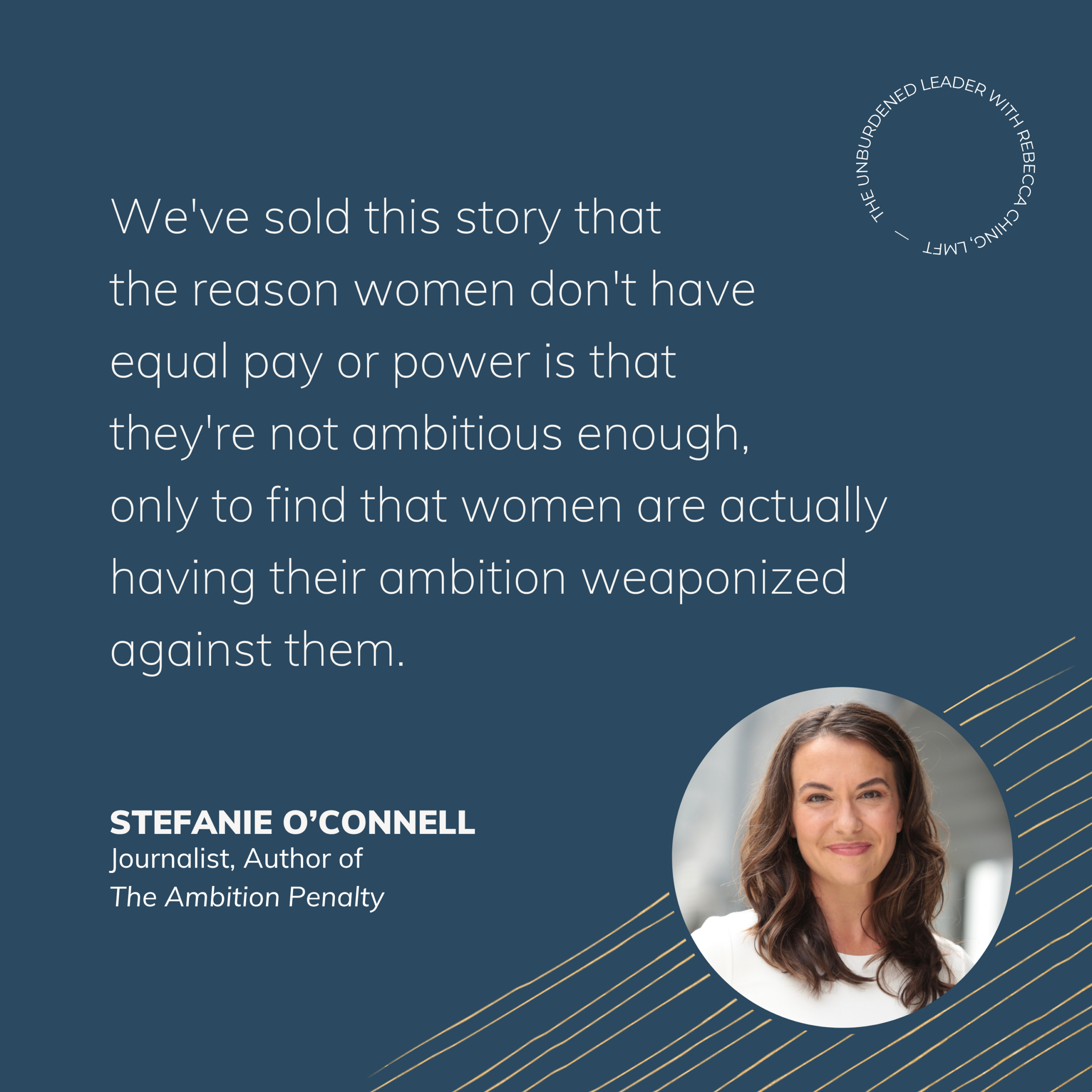
“For decades, we’ve sold women this story that the reason they don’t have equal pay or power is because they’re not ambitious enough—only to find that women are actually having their ambition weaponized against them.”
“To be ambitious simply means to have ambition.”
“Ambition is the drive to create a life that reflects your unique skills, interests, and values—and the desire to be valued for the qualities and abilities you value in yourself.”
“The ambition penalty is the sum of the professional, economic, social, and personal costs women face for their ambitions.”
“The behavior is not the issue. The issue is a system that treats that behavior as something good or bad depending on who is doing it.”
“‘He’s ambitious’ is used to affirm and uplift. ‘She’s ambitious’ is where it starts to shift.”
“This is as much a power problem as it is a gender problem.”
“Girls don’t threaten systems of power. It’s all about the potential of power when you foster a girl’s ambition.”
“When a girl becomes a woman, her assertion to power challenges a system that says power is to be rewarded to and held by men.”
“What women are experiencing is not by accident. It’s by design.”
“We’ve been conditioned to believe that the barrier is ourselves.”
“Aspirations erode over time—not because that’s what happens biologically to women, but because that’s what happens to anyone in an environment where they are chronically put down instead of lifted up, undersupported, and overworked.”
“It is not a gender trait. It is a gendered experience.”
“We are all living in a world that is constantly reinforcing broader ideals about what power is supposed to look like.”
“If you start from the baseline that we are all living with bias, it’s not a personal indictment.”
“Deconditioning is an active process.”
“When women are represented in leadership at scale, outcomes change.”
“The system incentivizes us to see one another as competition, even though the data shows that when women are in these positions together, outcomes improve for everyone.”
“Being curious about bias is a daily practice. It’s not a box to check.”
“Even when we learn to recognize the causes of our exhaustion as systemic, we still try to frame the solutions as individual.”
“You cannot take enough bubble baths to escape a world in which you are constantly being worn and torn down.”
“When you understand that the barriers are not inside you but around you, you start to understand that the barriers are not individual—they are shared.”
“Every meaningful movement that has shifted outcomes has been a collective movement.”
“Burnout is about your relationship with the world around you—not your relationship with yourself, your desires, or your wants.”
“What I don’t want to do is recast people being pushed out of the labor force, opportunity, economic autonomy, and power as empowering.”
“There has never been a lack of solutions. There is a lack of political will and a lack of collective action to bring that political power into place.”
“I wish I had thought more collectively sooner.”
“I wish I had understood that I didn’t have to do it alone and that I could be so much better served by coalition building.”
“You can better stand up to backlash when you’re in community because community gives you resilience.”
Conversation Highlights
01:00 — When Women’s Ambition Is Weaponized Against Them
Stefanie explains how women who ask, speak up, compete, and pursue advancement often receive penalties instead of the opportunities and rewards promised to them.
04:00 — Defining the Ambition Penalty
The professional, economic, social, and personal costs women face for pursuing the lives, recognition, power, and opportunities they value.
07:00 — Why “She’s Ambitious” Sounds Like a Warning
The same ambition celebrated in men is often treated as threatening, selfish, ungrateful, or incompatible with teamwork when expressed by women.
09:00 — The Double Standards That Disguise Inequality
Women may be considered too young or too old to lead, while men of the same ages are praised as innovative or experienced. The stated standard changes, but the unequal outcome remains.
10:00 — The Mass Gaslighting Machine
How systems recreate inequality while teaching women to interpret the consequences as personal deficiencies in confidence, skill, or ambition.
12:00 — Why Girls’ Ambition Is Celebrated Until They Become Women
Girls are encouraged to dream because their potential does not yet threaten existing power. The response changes once they become adults capable of claiming that power.
13:00 — The Shame That Erodes Women’s Aspirations
Many women privately identify as ambitious but hesitate to say so publicly. Stefanie explains how chronic backlash, under-support, and overwork gradually wear ambition down.
16:00 — How Women Can Reinforce the Systems Harming Them
A conversation about internalized bias, why women may judge other ambitious women, and why sharing an identity does not make anyone automatically objective.
18:00 — Token Representation Is Not Shared Power
Elevating one woman into leadership can leave her isolated and easy to dismiss. When women hold leadership positions at meaningful scale, pay gaps, promotion gaps, and organizational outcomes begin to change.
22:00 — When Empowerment Culture Meets Hustle Culture
Why “girl boss” messaging and individual self-optimization cannot resolve structural exhaustion, inequity, or the double standards women encounter.
23:00 — Bubble Baths Cannot Fix Systemic Burnout
Stefanie challenges the idea that self-care alone can solve exhaustion created by unsustainable workloads, limited control, inadequate rewards, weak community, unfairness, and misaligned values.
25:00 — From Individual Empowerment to Collective Action
Understanding that barriers are shared changes the solution: instead of confronting systems alone, people can build coalitions capable of shifting power and outcomes.
26:00 — Maslach’s Burnout Framework
Burnout includes exhaustion, cynicism or disengagement, and self-blame—and emerges from a mismatch between people and their environments.
28:00 — The Six Conditions That Shape Burnout
Workload, control, rewards, community, fairness, and values offer leaders and organizations a practical framework for identifying what is making work unsustainable.
32:00 — Why Being Pushed Out Is Not Empowerment
Stefanie challenges cultural narratives that reframe women losing access to paid work, earnings, leadership, and economic autonomy as simply “choosing differently.”
36:00 — Collective Power Begins in Everyday Life
Systems operate in homes, marriages, families, workplaces, communities, and politics. Each setting offers opportunities to question who receives power, whose labor is valued, and who is expected to sacrifice.
38:00 — How Gender Inequality Begins in Childhood
From household responsibilities and allowances to different behavioral expectations, children receive messages about gender, labor, power, and value long before entering the workplace.
40:00 — Solutions Exist When Collective Will Exists
Expanded childcare and pay-transparency initiatives demonstrate that supposedly impossible changes can happen when people build sufficient political and collective power.
41:00 — The Whisper Network That Closed a Pay Gap
A group of artists shared salary information and confronted producers together. Their collective willingness to walk away secured equitable pay.
42:00 — Quick Fire Favorites
My Mother’s Daughter by Tracy Clark-Flory, the Ragtime revival at Lincoln Center, rewatching Mad Men with new eyes, raising a child in New York City, and the mantra “Done is better than perfect.”
Closing Reflection
This conversation reminds us that ambition is not the problem.
The problem is a culture that celebrates ambition in some people and punishes it in others.
Women have been encouraged to lean in, speak up, ask for more, and claim their power—only to be labeled difficult, unlikable, selfish, aggressive, or ungrateful when they do.
Then, when the penalties accumulate, they are taught to look inward.
Maybe I asked incorrectly.
Maybe I was too confident.
Maybe I wasn’t warm enough.
Maybe I am the problem.
But exhaustion, disengagement, and eroding ambition are not evidence of personal failure.
They are predictable responses to environments where people are chronically overworked, under-supported, unfairly judged, and denied meaningful control, recognition, and community.
Recognizing this does not mean that we are powerless.
It means we must stop mistaking individual coping mechanisms for collective solutions.
Self-care can support us.
Rest can sustain us.
Leaving an unhealthy situation may sometimes protect us.
But none of these actions alone will change the conditions producing the harm.
And perhaps most importantly:
We were never meant to dismantle shared barriers by ourselves.
Real change happens when we name what is happening, compare experiences, share information, challenge the stories we inherited, and use our collective power to demand something better.
Because ambition becomes more resilient when it is witnessed.
Courage becomes more sustainable when it is shared.
And backlash becomes easier to withstand when we are surrounded by community.
💬 Reflection Prompt
Where have you been treating a shared or systemic barrier as a personal failure—and who could you connect with to begin replacing individual self-blame with collective understanding and action?













Comments +