
Every system we move through runs on norms: rules and agreements that are both explicit and implicit. And nowhere are they more powerful–or more invisible–than in how we lead and how we build our businesses.
In fact, sociologists have consistently found that norms don’t announce themselves.
They travel through families, schools, workplaces, and entire cultures through repetition and imitation, often persisting long after the conditions that created them have changed. We absorb them before we can name them. And once they are inside us, they feel like “just the way things are.”
In leadership development the norms run so deep we have mistaken them for truth. As a result, the model leader–despite decades of language to the contrary–still looks and sounds like a very particular kind of person.
My guest today offers that leadership development has been trying to make better leaders for a broken system, rather than questioning whether the system itself needs to change.
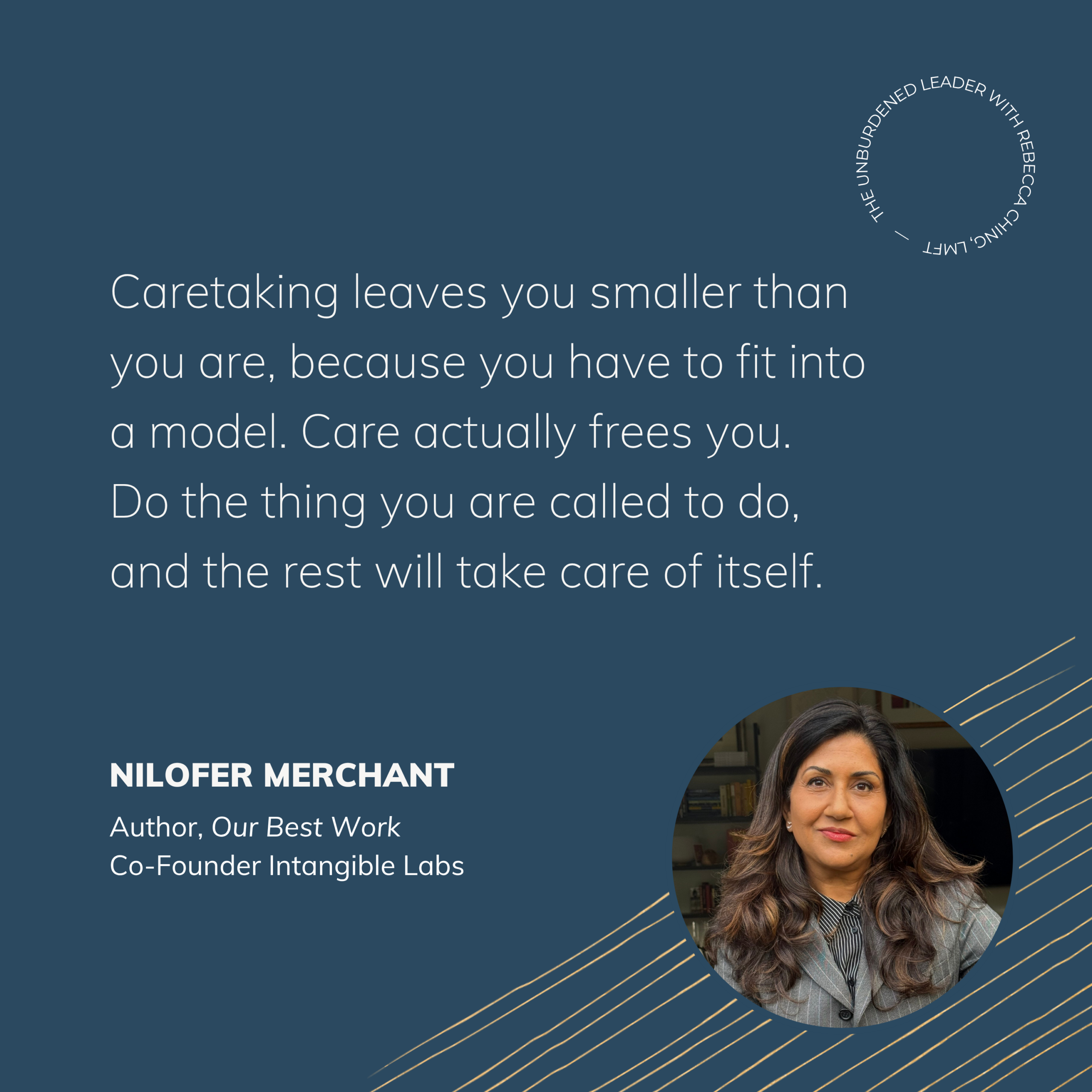
Nilofer Merchant has spent her career making the invisible visible–naming the norms, the systems, the daily routines that keep us collectively stuck. In this conversation, we go deep on the difference between caring and caretaking, what it means to trust yourself when the ground keeps disappearing, and what it actually takes to stop trying to fix what is not working and become someone who builds what is needed, right where you are.
Nilofer Merchant is the co-founder of Intangible Labs. She spent over 25 years leading technology companies (Apple, Autodesk, GoLive/Adobe) and personally launched over 100 products and services, netting $18 billion in revenues. She is ranked among the top 50 influential management thinkers in the world (one of her TED Talks has been referenced 300 million times). Our Best Work is her 4th book.
Listen to the full episode to hear:
- Why accepting our current norms won’t get leaders where they want to go
- How what we call personal agency is in reality socially constructed and driven
- Why we need more real care and less caretaking in our relationships at work and in life
- How teams can shift towards situational leadership and recentering how we think about the unique value and capabilities individuals bring
- How ownership, shared purpose, and co-creation help us build new systems, unstuck from the status quo
- Nilofer’s lessons about self-trust, taking risks, and approaching the future of work with hope
Learn more about Nilofer Merchant:
- Website
- The Intangible Labs
- Instagram: https://www.instagram.com/nilofer/
- Facebook: https://www.facebook.com/nilofer.merchant
- Connect on LinkedIn
- Our Best Work: Break Free from the 24 Invisible Norms That Limit Us
Learn more about Rebecca:
- rebeccaching.com
- Work With Rebecca
- The Unburdened Leader on Substack
- Sign up for the weekly Unburdened Leader Email
Resources:
- The Power of Onlyness: Make Your Wild Ideas Mighty Enough to Dent the World
- Mary Parker Follett
- Mother Mary Comes to Me, Arundhati Roy
- The God of Small Things, Arundhati Roy
- Prizefighter – Mumford & Sons
- Law & Order
- Dire Straits – Money For Nothing
- Duran Duran – Hungry like the Wolf
- The Curiosity Shop with Brené Brown and Adam Grant
Favorite Moments
“It’s literally the invisible things that are shaping our everyday world.”
“We’re not going to solve this problem by the same solutions we’ve used in the past.”
“Personal agency is not personal. It’s profoundly social.”
“If we choose people who make us smaller, we will become smaller.”
“Caretaking comes from a place of control. Care is love.”
“Care has no preconditions.”
“Policies of care matter more than perks in exchange for loyalty.”
“We’re not trying to fix what’s broken. We’re trying to build what’s needed.”
“Ownership is different than accountability.”
“Purpose is the thing none of us can do by ourselves, but we imagine we can do together.”
“I’m finally trusting myself.”
“Love always wins.”
“Hope isn’t soft. Hope breaks you free from the wreckage.”
Conversation Highlights
02:00 — The Invisible Norms Running Our Work Lives
Nilofer explains why so many organizations struggle to innovate despite knowing what healthy leadership looks like—and why the real barriers are often the invisible norms we’ve stopped noticing.
06:00 — Why Personal Agency Isn’t Actually Personal
The people closest to us shape what we believe is possible. Nilofer explores why meaningful change is always relational, not simply an individual effort.
09:00 — Care vs. Caretaking
A powerful distinction between genuine care and caretaking, how caretaking can become a form of control, and why many workplace relationships unintentionally reinforce dependency instead of freedom.
17:00 — Why Servant Leadership Isn’t Enough
Rebecca and Nilofer unpack why traditional servant leadership can unintentionally create unhealthy dynamics, and why situational leadership better supports innovation, autonomy, and shared ownership.
20:00 — Discovering Your “Onlyness”
Nilofer shares how every person’s unique combination of history, experience, gifts, and perspective creates value that no one else can replicate.
26:00 — Our Relationship with Uncertainty
Why our instinct to create certainty often limits creativity, and how trusting ourselves becomes an essential leadership practice.
30:00 — Scarcity, AI, and Leadership Through Fear
A thoughtful conversation about layoffs, technological disruption, and why fear often becomes a tool for preserving existing power structures rather than creating healthier organizations.
33:00 — Stop Fixing the Castle. Build the Village.
One of the episode’s most memorable metaphors: instead of endlessly trying to repair broken systems, what if we invested our energy in creating new ones that reflect the values we actually want to live by?
35:00 — Ownership Instead of Accountability
Nilofer reframes accountability through the lens of ownership, inviting leaders to move beyond power-over dynamics toward shared responsibility and co-creation.
39:00 — Learning to Trust Yourself
Through stories about writing her latest book, recovering from a brain injury, and navigating profound personal loss, Nilofer reflects on what it means to stop outsourcing your inner authority.
47:00 — Hope as a Leadership Practice
Why hope isn’t wishful thinking, but an act of courage that allows us to build toward a future we cannot yet fully see.
Closing Reflection
Many of the systems we work inside weren’t intentionally designed to help people flourish.
They’re built on invisible assumptions about power, productivity, certainty, and success.
Changing those systems can feel overwhelming.
But as Nilofer reminds us, transformation doesn’t begin by fixing every broken structure.
It begins by choosing to build something different.
To trust your own perspective.
To care without controlling.
To create communities rooted in ownership instead of fear.
And to believe that another way of leading is possible—even before you have proof.
Sometimes the most courageous leadership isn’t renovating the old castle.
It’s walking down to the river and building a new village.
Reflection Prompt
Where in your life or leadership are you spending energy trying to fix a system that may never become what you need?
What might it look like to begin building something new instead?







Comments +