

When you think of networking, do you feel discomfort or even dread?
Most of us learned that “networking” is fundamentally transactional, asking for and doling out favors in order to further our aims. Maybe you or someone you know is the type to be constantly trying to connect people to prove their own worth, or counting themselves out because they feel like they have nothing to offer. That’s the kind of networking that makes us go, “Ugh, I’d rather stay home.”
But networking can be about building real, powerful connections. And we need relationships, networks, and communities more than ever.
And you don’t have to be a dedicated extrovert. You can cultivate a way of building connections and community that works for your nervous system and your lifestyle. The goal is discernment–knowing when to give, when to receive, and trusting that you have something worth bringing.
As my guest today shares, if we want to redefine networking, it starts with checking our biases and our burdens about what and who networking is and who it’s for.
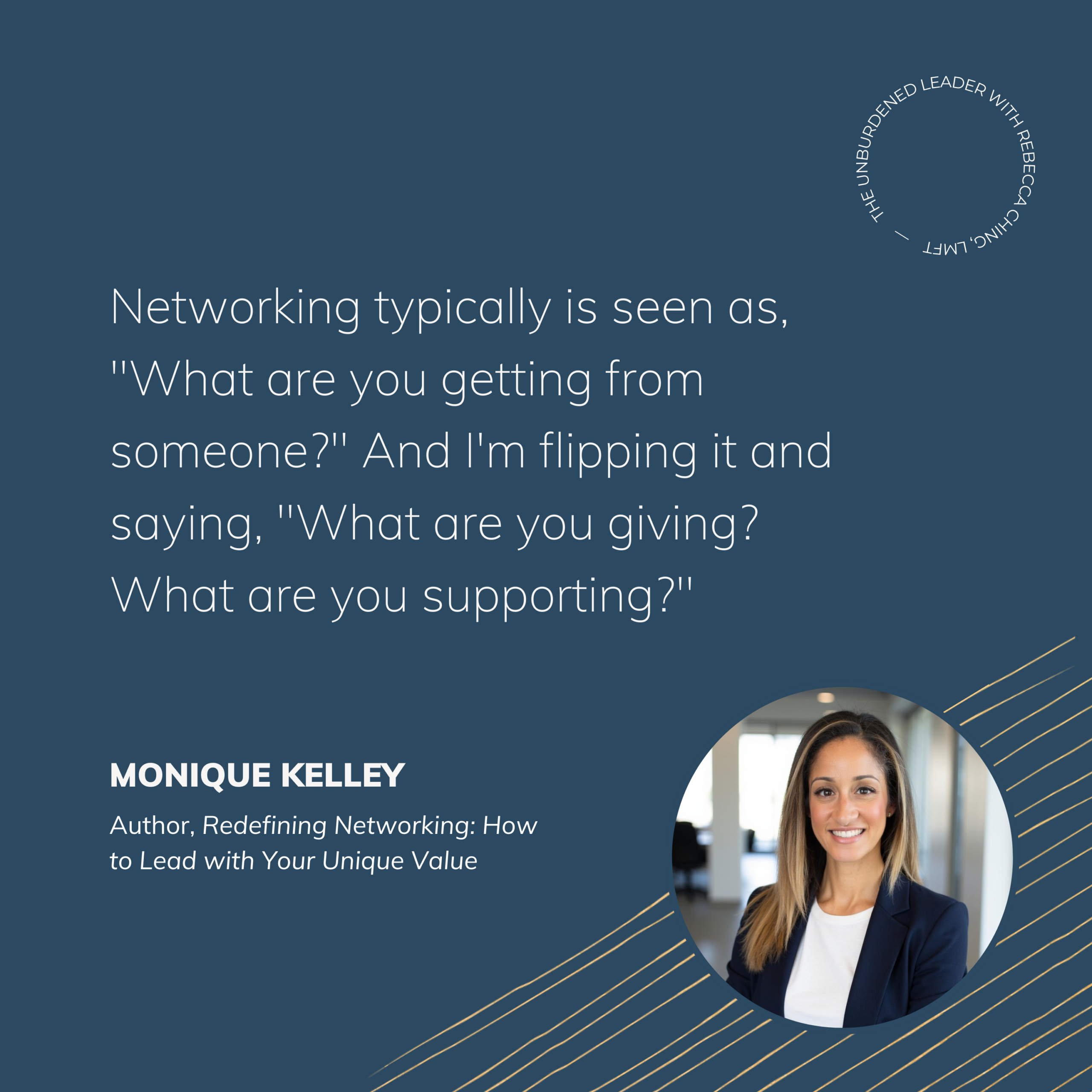
Monique Kelley is a trusted, purpose-driven professor at Boston University, a consultant and published author who serves in a fractional capacity for Fortune 50 and global biopharmaceutical companies seeking a strategic corporate, product or executive communications head who advances business objectives and alleviates their headaches. Professor Kelley wrote the book (literally) on effective networking, Redefining Networking: How to Lead with Your Unique Value. She is also a Boston Founding Member of women C-suite and executive community CHIEF.
Monique has built a strong network that she taps into for her consulting, referrals for her former coworkers and opportunities for her students and industry peers. At BU, she teaches the first and only Career Readiness course within the College of Communication. She teaches students and professionals alike her approach to effective networking and has facilitated “lead with your value” workshops for corporations and professional organizations, including Johnson & Johnson’s Global Commercial Strategy Organization and Ticket to Biotech.
Listen to the full episode to hear:
- How to reach out without making it transactional
- Why networking should start with people you already know, not strangers
- Simple steps for connecting and communicating your unique value
- Why you have to take the time to build equity and trust before making an ask
- Why reciprocity and long-term relationships are the real goals of networking
- How thinking about what you can contribute in return can take the pressure off asking for help
Learn more about Monique Kelley:
Learn more about Rebecca:
- rebeccaching.com
- Work With Rebecca
- The Unburdened Leader on Substack
- Sign up for the weekly Unburdened Leader Email
Resources:
- My journey to find friends helped me find community instead | Shannon Watts
- Dorie Clark
- Adam Grant
- The Devil Emails at Midnight: What Good Leaders Can Learn from Bad Bosses, Mita Mallick
- EP 139: Bad Bosses Aren’t Born, They’re Made: Breaking Toxic Leadership Cycles with Mita Mallick
- The Roots
- John Candy: I Like Me
Favorite Moments
“Networking isn’t the problem—the way we’ve been taught to do it is.”
“Transactional networking is: I only reach out when I need something.”
“Don’t treat people like vending machines.”
“Start with curiosity—not an ask.”
“If it would feel bad receiving your message… don’t send it yet.”
“Networking should feel like relationship building—not favor collecting.”
“Your network doesn’t need to be big—it needs to be real.”
“Play connector. That’s one of the fastest ways to add value.”
“We can’t expect people to know our value if we’re not clear on it ourselves.”
“Stop trying to get—start thinking about what you can give.”
“Earn your keep.”
“Deposit before you withdraw.”
“The best time to network is when you need nothing.”
“This isn’t math. You don’t give A to get B.”
“If it feels energy-giving, you’re doing it right.”
“Be a good human—and it tends to come back around.”
“Networking is just being human while the world becomes more automated.”
“Leadership isn’t a title—it’s impact.”
“You don’t need to work a room—you need to build a relationship.”
Conversation Highlights
02:00 — Why Networking Feels So Polarizing
Why some people love it—and others completely avoid it.
04:00 — What Transactional Networking Really Is
The “one-and-done” outreach: only reaching out when you need something.
08:00 — Signs You’re Networking Transactionally
Red flags like cold asks, lack of relationship, and ignoring context.
12:00 — How to Make Outreach Feel Human Again
Starting with curiosity and reconnection instead of requests.
16:00 — Overthinking vs Not Reaching Out at All
Why fear of “bothering people” can block meaningful connection.
20:00 — How to Add Value (Even Without Being Asked)
Becoming a connector and listening for opportunities to help.
25:00 — Helping Your Network Know You
Why clarity on your own value is the foundation of everything.
30:00 — Inclusive & Accessible Networking
Adapting communication styles and making space for different ways of connecting.
35:00 — What to Do When You Actually Need Something
How to ask for help without sounding transactional or entitled.
40:00 — Long-Term Relationship Thinking
Why networking is a long game—and how opportunities evolve over time.
45:00 — Where Trust Gets Built (and Broken)
Earning your keep, building credibility, and respecting boundaries.
50:00 — “Earn Your Keep” Explained
Shifting from “what can I get?” to “what can I contribute?”
55:00 — Deposit Before You Withdraw
Why giving first reduces pressure and builds stronger relationships.
1:00:00 — Showing Up Without an Agenda
How authentic connection leads to unexpected opportunities.
1:05:00 — When You Feel Like a Burden
Reframing asking for help and leading with your value instead.
1:10:00 — The “Pick Your Brain” Problem
Navigating generosity vs respecting people’s time and expertise.
1:15:00 — Fear, Avoidance & Outdated Models
How old networking norms create anxiety—and what to do instead.
1:20:00 — Do We Need a New Word for Networking?
Reframing networking as simply being human and building connection.
1:25:00 — Redefining Leadership
From titles and authority to impact, influence, and contribution.
Closing Reflection
This conversation flips networking on its head:
👉 It’s not about asking
👉 It’s not about working the room
👉 It’s not about collecting contacts
It’s about:
- Building real relationships
- Staying curious about people
- Contributing before expecting
And most importantly:
👉 Being a good human consistently—not just when you need something
Because over time:
Relationships compound.
💬 Reflection Prompt
Where in your life could you shift from “What can I get?” to “What can I give?”









Comments +