

We’ve all had bad bosses.
We might have even been one. At the very least, we’ve probably let people down who counted on us.
We all carry burdens from our past that show up in how we lead. And we’re all confronting systems that foster toxic workplace cultures where overwork and blurred boundaries are the norm, spaces that don’t feel safe or generative, and where there is little to no accountability.
The question we face is simple, but urgent: How do we want to lead?
Our leadership can reinforce toxic systems and norms. Or we can learn to recognize our own burdens and do the work to become more aware, adaptable, and flexible. We can create spaces where people feel seen, heard, and valued, even when systems feel unstable or unfair.
Because leading is about deciding, in every moment, whether we respond from our burdens or from our values.
And my guest today helps us reflect on those choices and decide how we want to lead through her own lived experiences with bad bosses.
Mita Mallick is a Wall Street Journal and USA Today bestselling author who is on a mission to fix what’s broken in our workplaces. She’s a corporate change maker with a track record of transforming businesses and has had an extensive career as a marketing and human resources executive.
Mallick is a highly sought-after speaker who has advised Fortune 500 companies and start-ups alike. She is a LinkedIn Top Voice and was named to the Thinkers 50 Radar List. She’s a contributor to Harvard Business Review, Fast Company, Adweek, and Entrepreneur. Mallick has been featured in The New York Times, The Wall Street Journal, The Washington Post, Time Magazine, Forbes, Axios, Essence, Cosmopolitan Magazine and Business Insider.
Listen to the full episode to hear:
- Three scenarios where leaders commonly shift into being bad bosses
- Key reasons why we tolerate bad bosses and what we can do to shift the culture
- Why Mita’s 13 archetypal bad bosses persist in our workplaces
- Why leaders have to invest time and connection in their team members if they want to retain them
- Why another executive coaching program will not fix a truly bad boss
- The number one skill leaders can focus on to become a better boss
- Why corporate America needs more humility and vulnerability
Learn more about Mita Mallick:
- Website
- Connect on LinkedIn
- Reimagine Inclusion: Debunking 13 Myths to Transform Your Workplace
- The Devil Emails at Midnight: What Good Leaders Can Learn from Bad Bosses
Learn more about Rebecca:
- rebeccaching.com
- Work With Rebecca
- The Unburdened Leader on Substack
- Sign up for the weekly Unburdened Leader Email
Resources:
- EP 102: Toxic Leadership: The True Cost of Workplace Trauma with Mita Mallick
- Give and Take: A Revolutionary Approach to Success, Adam Grant
- The Fearless Organization: Creating Psychological Safety in the Workplace for Learning, Innovation, and Growth, Amy C Edmondson
- The Normalization Of Corruption In Organizations, Blake E. Ashforth and Vikas Anand
- Managing to be ethical: Debunking five business ethics myths, Linda Klebe Treviño and Michael E. Brown
- Examining the Link Between Ethical Leadership and Employee Misconduct: The Mediating Role of Ethical Climate, David M. Mayer, Maribeth Kuenzi, Rebecca L. Greenbaum
- The Body Keeps the Score: Brain, Mind, and Body in the Healing of Trauma, Bessel van der Kolk M.D.
- The Pocket Guide to the Polyvagal Theory: The Transformative Power of Feeling Safe, Stephen W. Porges
- Primal Leadership: Unleashing the Power of Emotional Intelligence, Prof Daniel Goleman PH D, Richard E Boyatzis, and Annie McKee
- Psychological Conditions of Personal Engagement and Disengagement at Work, William A. Kahn
- Emotional Intelligence: Theory, Findings, and Implications, John D. Mayer, Peter Salovey, David R. Caruso
- Working with Emotional Intelligence, Daniel Goleman
- The 5Ds of Bystander Intervention – Right To Be
- EP 52: Charlie Gilkey: Leading With What Matters Most
- EP 85: Team Habits: Redefining Workplace Dynamics with Charlie Gilkey
- Big Magic: Creative Living Beyond Fear, Elizabeth Gilbert
- The Anxious Achiever: Turn Your Biggest Fears Into Your Leadership Superpower, Morra Aarons-Mele
- Sia – Unstoppable
- The Sopranos
- Breaking Bad
- Fresh Off the Boat
- The Fresh Prince of Bel Air
Favorite Moments
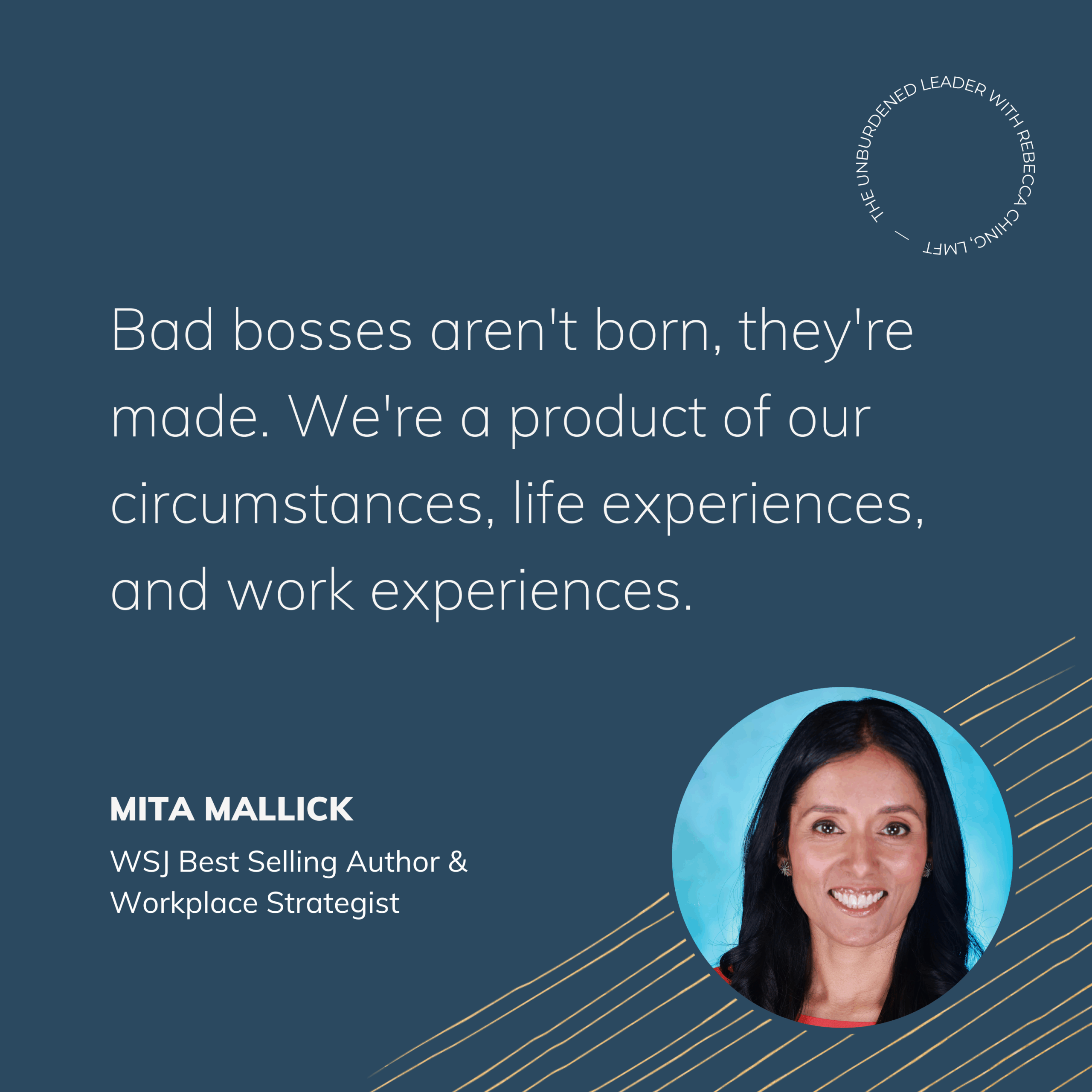
“Bad bosses aren’t born — they’re made.”
“What if I’m in someone else’s notebook?”
“Most of us know when we’re behaving badly.”
“We don’t need another coach — we need therapy.”
“If you can’t make time for your team, why are you leading?”
“Time is the most precious commodity.”
“Have the courage to cancel a meeting.”
“Use that time to do work at work.”
“We don’t have enough humility in our workplaces.”
“My job as a leader is to create more great leaders.”
“Sprinkle kindness everywhere.”
Conversation Highlights
00:00 — The Origin of “The Devil Emails at Midnight”
Mita introduces her book and its provocative premise: we’ve all been (or could be) the bad boss. The title reflects those leaders who ignore people during the day—but demand everything late at night.
01:00 — The Mirror Moment
Mita shares the powerful story of finding a journal from her 20s listing all her bad bosses—then realizing: what if she’s in someone else’s version of that list?
03:00 — Why the Book Starts With Accountability
Instead of blaming others, Mita invites leaders to look inward. Real change only happens when we stop pointing fingers and examine our own behavior.
Bad Bosses Are Made (Not Born)
05:00 — The 3 Triggers of Bad Leadership Behavior
Mita outlines when bad boss tendencies show up most:
- External pressure (market shifts, competition, failure)
- Working under a bad boss (behavior trickles down)
- Personal life stress (grief, illness, major life events)
The Story That Changed Everything
10:00 — The “Sheriff” and Workplace Harm
Mita shares a deeply personal story of a boss who repeatedly called her by the wrong name. The impact wasn’t just the behavior—it was the silence of others who witnessed it.
14:00 — Why Silence Hurts More Than the Harm
Often, the most lasting pain comes not from the person who caused harm—but from those who saw it and said nothing.
Why We Tolerate Bad Bosses
16:00 — Survival Mode at Work
Many people tolerate toxic behavior because they’ve been conditioned to endure—whether through upbringing, trauma, or workplace culture.
17:00 — The Real Reasons We Stay Silent
- Fear of consequences
- Loyalty or personal relationships
- “That’s just how it is” thinking
- Not knowing what to do
- Lack of power
What To Do Instead (Practical Tools)
18:00 — The “Distract” Strategy
Using humor or redirection to safely interrupt harmful moments in real time.
20:00 — What Happens After the Moment
- Check in with the person affected
- Ask how you can support
- Document what happened
- Involve people with power when needed
The Archetypes of Bad Bosses
36:00 — Medusa (Fear-Based Leadership)
A boss who leads through intimidation, yelling, and emotional volatility. This creates:
- Short-term performance
- Long-term burnout and disengagement
41:00 — Tony Soprano (The Talent Hoarder)
A leader who demands loyalty and blocks growth, keeping people stuck to maintain control and status.
The Real Leadership Problem
29:00 — It’s Not Midnight Emails — It’s Time
The deeper issue isn’t just behavior—it’s how leaders misuse time and avoid meaningful connection with their teams.
30:00 — Meetings vs. Meaningful Leadership
Leaders often:
- Over-schedule
- Avoid 1:1s
- Spend time reactively instead of intentionally
A Better Way to Lead
47:00 — The Power of Self-Awareness
Leadership starts with asking:
“How did I show up today—and how did it impact others?”
48:00 — Career Journaling as a Tool
Reflect weekly on:
- Your behavior
- Your emotional impact
- How others responded
Feedback, Humility & Growth
49:00 — How to Ask for Feedback (Without Triggering Fear)
Instead of open-ended questions, share:
- What you’re working on
- Where you want coaching
- Give people time to think
50:00 — Why Humility Is Missing
Many leaders struggle to admit mistakes because they equate leadership with being “right.”
Redefining Leadership
52:00 — From Power to Service
Mita reframes leadership:
It’s not about authority — it’s about creating more leaders.
Navigating Today’s World
53:00 — Staying Grounded in Uncertainty
In a chaotic world, focus on what you can control:
- How you show up
- How you treat people
- How you lead at home and work
Final Reflection
Leadership isn’t about avoiding mistakes.
It’s about:
- noticing them
- owning them
- and choosing to do better
Because the real question isn’t:
“Have I had a bad boss?”
It’s:
“Where might I be one… without realizing it?”
💬 Reflection Prompt
If someone wrote about you in their “bad boss notebook”…what would you hope they’d say?











Comments +