

When the stakes rise and more is on the line, everything about visibility shifts –– what it means, what it costs, and what it asks of you.
And if you ever experienced bullying, relational trauma, betrayal, or abuse, visibility can be more than just awkward or uncomfortable. Unprocessed echoes of those burdens can make the past feel like it is happening in the present.
We have to do the work of building more trust within, getting clear on who and what really matters, and learning to follow our values even when we do not know the results.
As my guest today reminded me, when we go silent, we may feel safe, but our voices are not out there, and others will step in to define the direction of conversations and the topics that matter most to us.
Showing up and letting people see and hear you isn’t always easy, but with practice and courage, we can reshape the narratives we carry about ourselves and our visibility.
Mike Ganino works with professional speakers, keynote speakers, and executives to help them create transformative speaking experiences worthy of standing ovations. As a keynote director with a background as an actor, writer, director, producer, hospitality executive, and corporate trainer, Mike learned to view storytelling and performance from the audience’s perspective and uses these insights and experiences to help his clients develop talks and performances that go beyond just wowing the audience to truly transform their thinking.
Listen to the full episode to hear:
- How a fourth-grade substitute teacher showed Mike the power of making people feel seen
- Why getting comfortable with visibility requires us to address the relational wounds that have kept us quiet
- What we can learn from actors about the choices we make as we show up and interact with others
- Why developing as a speaker is a physical practice before it’s an intellectual practice
- Two essential elements for telling an effective story
- How fears of losing status and being misunderstood keeps us from showing up for ourselves and others
Learn more about Mike Ganino:
- https://mikeganino.com/
- Instagram: @mikeganino
- Facebook: @mikeganino
- Connect on LinkedIn
- Make a Scene: Storytelling, Stage Presence, and the Art of Being Unforgettable in Every Spotlight
Learn more about Rebecca:
- rebeccaching.com
- Work With Rebecca
- The Unburdened Leader on Substack
- Sign up for the weekly Unburdened Leader Email
Resources:
Favorite Moments
“We have a lot of say over how we are interpreted in a room, and then what’s possible in that room because of that interpretation.”
“The only way that you can fix a relational issue is in relation.”
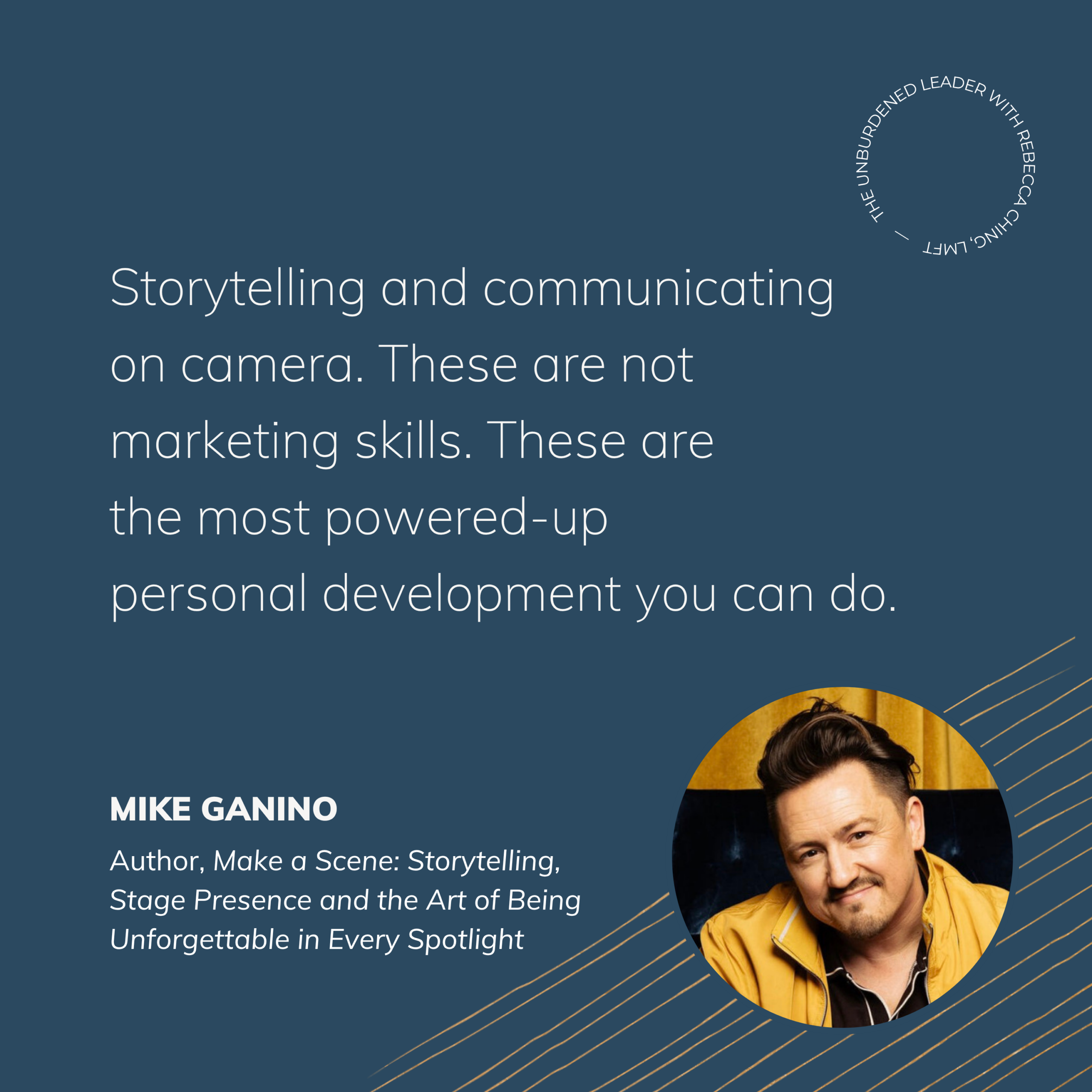
“Public speaking, storytelling, and communicating on camera are not marketing skills. These are the most powered-up personal development you can do.”
“If you want to show up, and there’s some stuff stopping you from going where you want to go, I’m that guy.”
“We’re all always performing anyway.”
“There is no one authentic version of you.”
“Those are not fake versions of me. They are just the versions I’m employing to get a job done.”
“What am I trying to get done here? What actions do I need?”
“What is possible for you? And then what are you trying to get done?”
“Everything under the sun becomes new when you learn to pay attention to what you pay attention to.”
“You can change the way everyone treats you, and you can change how they see what’s going on by the way you show up in the room.”
“Public speaking is a physical job before it’s a mental content job.”
“It’s all about understanding the range and being intentional.”
“What did you think? What did you feel? What were you worried about? What were you hoping would happen?”
“Why did I pay attention to that? Why did I notice it?”
“We really struggle to tell stories that make us look bad.”
“The fear of public speaking and making videos is often the fear of losing status.”
“We are so worried about being misunderstood that we don’t say anything—and then we are misunderstood.”
“Who you get notes from matters.”
“We don’t have to take notes from everybody, because we aren’t trying to talk to everybody.”
“The job is to post the video. That’s success.”
“I think I was always a survivor.”
“Leadership is helping people have a reason to go to a new place.”
“At what point do we integrate what we know so it can actually help us change?”
“Who I’m being is far more important than any little lesson I’m trying to teach.”
“You can drastically change your life if you change the way you communicate.”
Conversation Highlights
01:00 — The Fourth-Grade Teacher Who Changed the Room
Mike remembers two teachers who made students feel seen during a season of loss and instability—and the early lesson that how we enter a room can change what becomes possible inside it.
06:00 — When Visibility Has Not Felt Safe
Mike reflects on bullying, hiding, and the ways he stayed small while still pursuing the achievements that could help him build a different life.
08:00 — Healing Relational Wounds Through Relationship
Why insight alone may not undo fear of visibility—and how supported experiences of speaking, performing, and being seen can begin to reshape old stories.
10:00 — Creating Safer Repetitions on Camera
Mike explains why sharing with a small online audience can offer a relatively contained place to practice visibility, especially when people can moderate comments and choose their boundaries.
12:00 — Knowing the Scope of the Work
A clear distinction between therapeutic support for significant trauma and coaching for people who want to speak or create but feel blocked by discomfort, habit, or limited experience.
14:00 — Authenticity Versus Intentional Performance
Mike challenges the idea that there is one fixed “authentic self” and draws from acting to show how we naturally make different choices depending on the relationship, context, and goal.
18:00 — Does the World Really Need Another Voice?
For people who worry they have nothing original to say, Mike offers a reframing: what makes an idea meaningful is often the particular lens, experience, and language through which it is shared.
21:00 — The Most Common Visibility Blocks
Why many people underestimate the physical dimensions of speaking, including movement, posture, vocal range, pacing, and the habits that shape how a message lands.
24:00 — Gender, Voice, and Speaking Habits
Rebecca and Mike discuss how similar communication habits may be interpreted differently depending on gender—and why expanding one’s range matters more than conforming to one “correct” style.
28:00 — Communication as an Instrument
A look at how pauses, pitch, movement, vocal fry, intensity, and restraint can all serve a message when they are used intentionally rather than habitually.
29:00 — Supporting Neurodivergent Speakers Without Encouraging Masking
Mike emphasizes working with the range available to each person rather than training them to imitate a supposedly ideal speaker.
30:00 — Storytelling as a Path Toward Integration
Why effective stories are not built from decorative detail alone, but from honestly naming what we thought, felt, feared, wanted, and hoped would happen.
32:00 — Getting Curious About Your Curiosity
Rebecca and Mike explore how noticing what captures our attention can reveal the stories, values, and ideas that are uniquely ours to communicate.
34:00 — The Fear of Losing Status
Why people often avoid stories that could make them appear imperfect, unlikable, inexperienced, or difficult—and how that fear can prevent honest communication and advocacy.
36:00 — How Avoiding Misunderstanding Creates More of It
Silence can leave others to fill in the blanks. Mike explains how the attempt to control perception may keep leaders from sharing ideas, giving feedback, and allowing the right people to know them.
39:00 — Visibility, Criticism, and Belonging
Rebecca shares the backlash she received when launching the podcast and how trusted relationships helped her distinguish between feedback that mattered and criticism that did not.
40:00 — Choose Who Gets to Give You Notes
A practical boundary for visibility: identify the people whose feedback aligns with the work you are doing and stop treating every online reaction as equally meaningful.
42:00 — Redefining Success Through Repetition
Why a small, measurable goal—such as publishing one video each day—can build more meaningful confidence than chasing approval, virality, or universal praise.
43:00 — What His Younger Self Might See Now
Mike reflects on the life he has built, the work he gets to do, and the survival instincts that carried him from a small town into a visible, creative career.
44:00 — Leadership as a Shared Destination
Mike defines leadership as helping people see and believe in a meaningful destination, then supporting them as they figure out how to move toward it together.
45:00 — Focus, Feedback, and Integration
Why leaders do not need to absorb every idea or improve everything at once—and why intentional focus turns collected knowledge into genuine change.
47:00 — Quick-Fire Favorites
A book about the human face, Ariana Grande, E.T., the mantra “Make a scene,” a more nuanced relationship with AI, and the daughter who reminds Mike that children learn most from who we are.
Closing Reflection
Visibility is not only about standing on a stage, posting a video, or speaking into a microphone.
It is about relationship.
The relationship we have with our voices.
The relationship we have with our bodies.
The relationship we have with the people whose approval, misunderstanding, or rejection we fear.
And the relationship we build with the people who may need to hear what only we can say in the way only we can say it.
Mike reminds us that hiding can protect us from certain reactions, but it also removes our voices from the conversations shaping our work, relationships, and communities.
Showing up does not require becoming fearless, perfectly polished, or universally understood.
It asks us to become more intentional.
To know what we are trying to communicate.
To practice using the range available to us.
To choose carefully whose feedback gets to shape us.
And to define success by the courageous repetition of showing up, not by controlling how everyone responds.
Because storytelling is not merely a tool for marketing or influence.
It can help us notice what matters.
Name what we feel.
Understand what we fear.
And integrate parts of our lives that once seemed disconnected.
The goal is not to manufacture a more acceptable self.
It is to build enough trust within ourselves to communicate with greater clarity, choice, and courage.
💬 Reflection Prompt
Where are you staying silent because you fear being misunderstood—and whose feedback do you truly want to guide your next step toward being seen?






Comments +