

A lot of people feel like they know who they’re supposed to be, how they’re supposed to show up, and what they’re supposed to value, and they assume those things come from themselves instead of external influences.
But we all have internalized beliefs and expectations from others, our culture, and the systems we live in. It takes a beat, sometimes a long one, to get clear on who you actually are and what is actually important to you. It requires building the kind of deep self-trust that allows you to act from your values even when the world is suggesting otherwise.
And if you carry relational wounds or other interpersonal or socio-cultural burdens, those experiences can slow down or block your capacity to deepen self-trust, trust in others, grow in courage, and fully inhabit your whole story. That is not a character flaw. It is a developmental reality.
My guest today models what becomes possible when you stop performing the version of yourself the world approved of and start trusting yourself and leading from that space. She is building a career and a creative practice rooted in self-trust and values alignment, and she is far from done.
MILCK, born Connie K. Lim, is a self-proclaimed gentle rebel whose artistry and advocacy is fueled by her music. Her breakout anthem “Quiet” became a global sensation, championing women’s rights and resonating with movements around the globe. MILCK has collaborated with notable artists such as John Legend, Natasha Bedingfield, Phillipa Soo, Ani DiFranco, Aloe Blacc, and LeAnn Rimes, blending soulful melodies with poignant, socially conscious lyrics.
Beyond the recording industry, MILCK is expanding her creative reach into musical theater, advocacy, and mentorship; MILCK and artists Sam Chanse, Jess Mcleod, and AG have partnered with La Jolla Playhouse to develop The Family Album, an award-winning seriocomedy musical. Inspired by MILCK’s life journey, the musical explores themes of healing and family.
Listen to the full episode to hear:
- How “Quiet” began as a means to process her own story and turned into an anthem
- How personal, creative, and therapeutic supports came together to help Connie find her truth and her voice and connect with audiences
- The discouragement of her dreams Connie received as a kid and why her younger self is delighted with her now
- How working on The Family Album has been healing for Connie and her family
- Developing the confidence and self-trust to push boundaries and be an emotional bridge
- How the all-female creative team behind The Family Album musical came together
Learn more about MILCK:
Learn more about Rebecca:
- rebeccaching.com
- Work With Rebecca
- The Unburdened Leader on Substack
- Sign up for the weekly Unburdened Leader Email
Resources:
- Childhood and Society, Erik H Erikson
- In Over Our Heads: The Mental Demands of Modern Life, Robert Kegan
- Roxy Music – Avalon
- Couples Therapy
- Tears For Fears
Favorite Moments
“Quiet is a song I wrote to release myself of some of that tension that’s in my body.”
“Sometimes when we hold these stories with shame or guilt, it creates these knots in our body.”
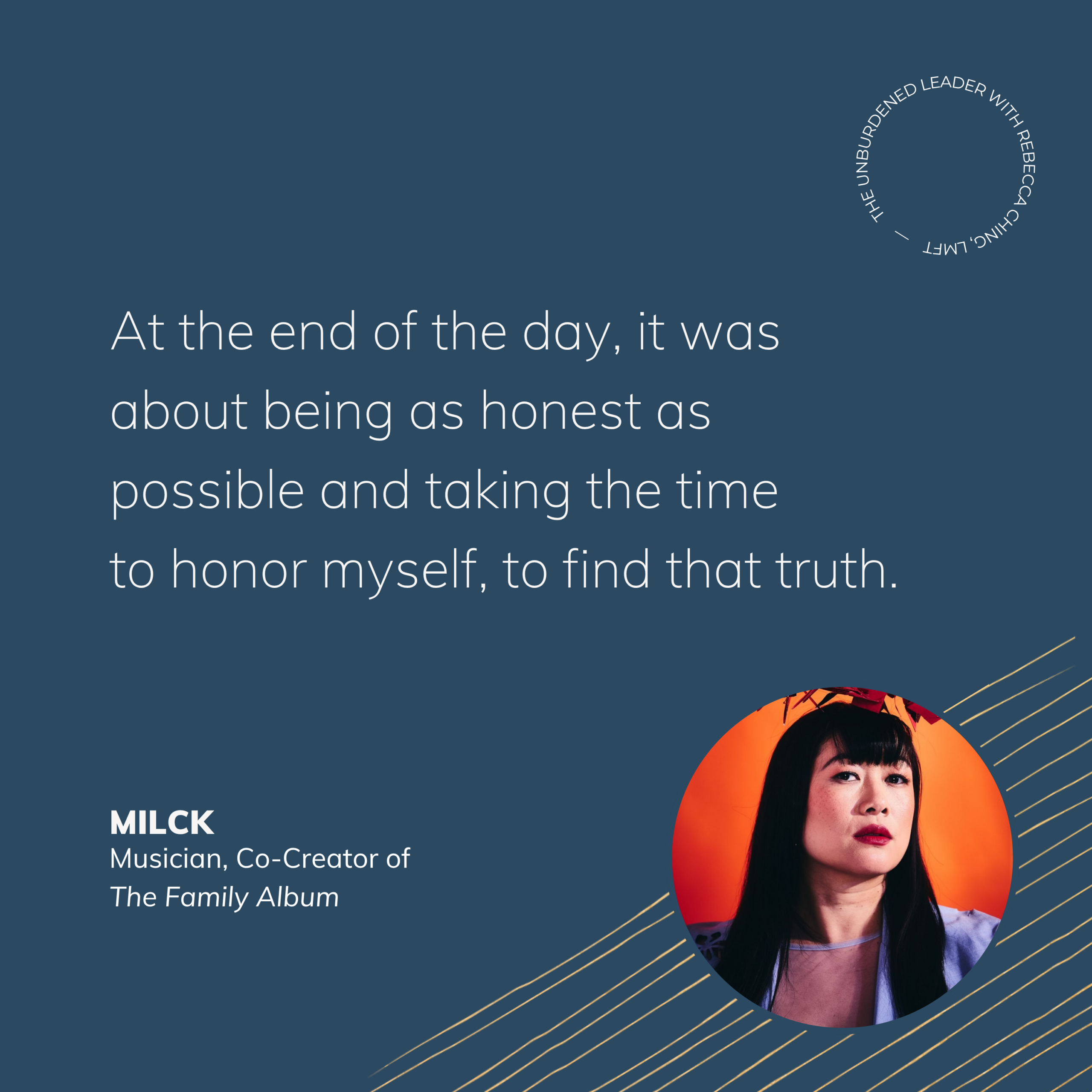
“At the end of the day, it was just about being as honest as possible and taking the time to honor myself—to find that truth.”
“A lot of times people are not expressing their truths because they actually don’t know their truths.”
“For artists, our job is to create the circumstances where we will discover our art more readily.”
“You have this voice in you that says one thing, but then you have to figure out what other people want to hear, and then you’ll be okay.”
“The act of creating something, naming something, and envisioning something better was a practice I was able to start early on.”
“My younger self is very happy, very delighted, and relieved that I listened to her.”
“There was this knowing that my younger self had that I have fought to return to—and now we walk in lockstep.”
“I need to let go and then trust the process.”
“We all kept showing up for each other in the best way we knew how.”
“How do we show up for ourselves, and how do we show up for each other, and how do we navigate the balance?”
“For me, my journey is to integrate and to be whole.”
“It’s not comfortable being a bridge, but there are some really cool things.”
“Just push to the edge a little bit.”
“The discoveries that come from being a bridge are worth it to me.”
“If water is not able to go forward, it will just find a way.”
“The human words are failing us, so let me just sing.”
“I don’t have full control over this story anymore. It’s become its own thing. So I’ve had to surrender.”
“We have practiced it by just continuing to show up—even if the conversation gets really hard.”
“Leadership is the art of navigating, growing, and directing trust.”
“I must trust myself as a leader. I must foster trust in the people I’m leading, mostly for themselves. I must trust the vision.”
“To have more practice with what we want is actually really revolutionary—and great for leadership.”
“I’ve been able to change my own mind from shame to curiosity and joy.”
“I am safe. I’m safe.”
Conversation Highlights
01:00 — Quiet: From Private Survival to Public Anthem
Connie shares how “Quiet” began as a way to release shame and tension from her body—and how telling the truth opened doors gatekeepers had kept closed.
03:00 — Honesty, Vulnerability & Finding Your Truth
Why meaningful art is less about inventing something impressive and more about creating the conditions to discover what is honest.
06:00 — The People Who Mirror Our Possibility
Connie reflects on the partner and creative collaborator whose belief helped her become ready for therapy, healing, and a fuller trust in herself.
09:00 — The Inner Voice That Said “Singer”
From singing through a dark hallway to abandoning paths that left her disengaged, Connie traces the voice that kept calling her back to music.
11:00 — Naming Something Beautiful
A childhood piano composition becomes an early lesson in agency: creating, naming, and imagining a more caring world.
14:00 — Returning to—and Caring for—Her Younger Self
Connie describes the peace of listening to the younger self she once overrode and turning family pain into a work made with love.
18:00 — Turning a Life Story into The Family Album
How the song “Oh Mother” insisted on being heard, why a musical became its home, and how fiction created enough distance to tell a deeper truth.
21:00 — Choosing Connection Without Abandoning Herself
A nuanced conversation about family, immigrant identity, boundaries, and why Connie chose a gray path instead of total closeness or complete cutoff.
25:00 — The Emotional Work of Being a Bridge
Connie names the tension of connecting divided worlds—and explains why discomfort can be worthwhile when it serves healing, wholeness, and growth.
27:00 — Pushing to the Edge Without Losing Yourself
A lesson from recovering from a fractured neck becomes a philosophy for relationships: test the boundary, listen closely, and trust yourself to return.
31:00 — When Human Words Begin to Fail
Faced with complex global conflict, Connie turns toward community, ancestors, nature, and the wisdom of water—then chooses to sing.
35:00 — How an All-Women-of-Color Creative Team Built Trust
The origin story of Connie’s collaborators—and the honest conversations, creative autonomy, repair, and mutual encouragement behind their five-year partnership.
41:00 — Surrendering Control of Your Own Story
What it means to let trusted collaborators shape deeply personal material while still asking for care, space, communication, and consent.
44:00 — “We Did It” and “What Have I Done?”
Connie holds the exhilaration and terror of seeing her life transformed onstage—and names art as a path toward healing and more humane leadership.
45:00 — Leadership as the Direction of Trust
Connie defines leadership through self-trust, trust in others, trust in the vision, and the revolutionary clarity of knowing what you want.
47:00 — Quick Fire Favorites
Roxy Music’s “Avalon,” Couples Therapy, Tears for Fears, the mantra “I am safe,” strong oat-milk opinions, and moving from shame to joy in a child-free life.
Closing Reflection
This conversation reminds us that finding our voice is rarely one brave moment.
It is a return.
A return to the younger self who knew.
A return to the body that has been carrying the truth.
A return to the relationships that can hold honesty, difference, repair, and trust.
Connie’s story refuses the false choice between truth and love, autonomy and connection, courage and fear.
Instead, she shows us the creative power of staying in the tension—of becoming a bridge without pretending the bridge is comfortable.
And perhaps most importantly:
Art can give language, music, and movement to what once had to remain quiet.
Because healing does not always mean having full control of the story.
Sometimes it means trusting yourself enough to let the story become something larger than you.
💬 Reflection Prompt
What truth, desire, or creative impulse inside you is asking to be heard—and what would it look like to create the conditions for it to emerge?



Comments +