

How many times have you talked yourself out of pursuing an opportunity, telling yourself it wasn’t for you, that you weren’t ready, or you weren’t qualified?
What if that hesitation wasn’t self-awareness but a script you internalized?
Many women have a complicated relationship with their ambitions for greater leadership and greater wealth. And it isn’t because women are somehow inherently less suited for leadership or financial independence. The systems of power, patriarchy, sexism, and misogyny that we live in every day shape the voice in women’s heads that tells them they’re not meant to be a leader.
We are in a political and cultural moment where women’s rights and autonomy are facing incredible pushback at all levels. It’s vital that we examine our internalized biases towards ourselves and others, where we limit our ambitions for roles we have the skills and abilities for, and where we’re giving up our power because of the stories we’ve been told by our society.
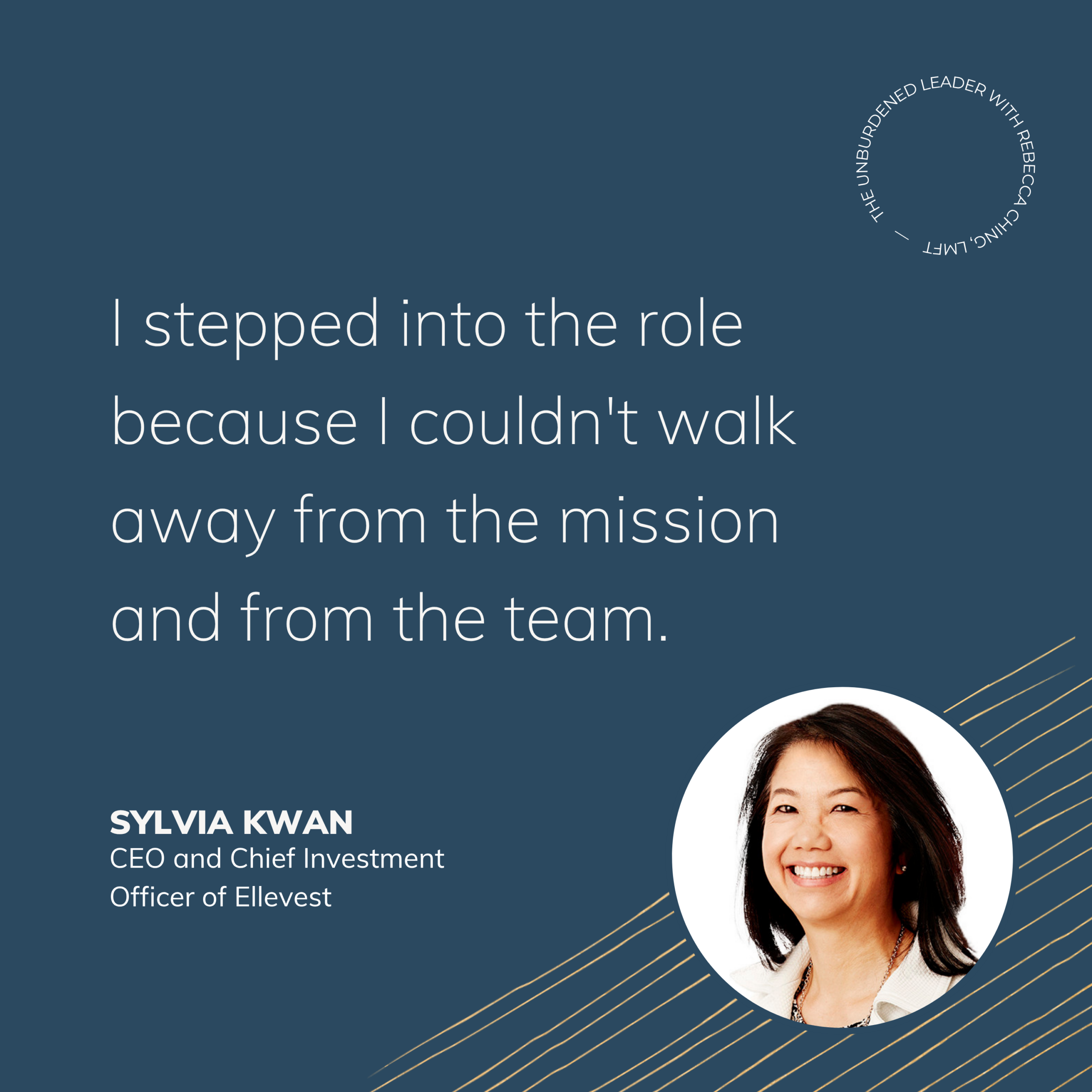
My guest today is a beautiful example of a woman who hadn’t considered herself for a CEO role, but who stepped into the position and has grown into the kind of leader we just might need most right now. In our conversation, we talk a lot about women and finances and also about what we believe about our abilities and the opportunities we deserve to pursue.
Sylvia Kwan is a Chartered Financial Analyst with more than 30 years of industry experience. Prior to Ellevest, she founded SimplySmart Asset Management and held senior portfolio management positions at Financial Engines and Charles Schwab. Sylvia serves on the Board of Exit 182, the investment committee that oversees the endowment of Grinnell College.
Listen to the full episode to hear:
- How Sylvia’s commitment to Ellevest’s mission bolstered her through the abrupt and sometimes isolating shift into being CEO
- How she navigated the tension between wanting to be transparent with her team and needing to project calm
- The scripts about who she is and the work she excels at that Sylvia had to rewrite, and why it’s a continuing process
- How the financial industry subconsciously reinforces sexist ideas about women and money
- Why taking the stigma out of women talking about money is a key piece of closing the gender wealth gap
- How women accruing wealth actually supports communities and creates more equity
- How convoluted jargon and perfectionism keep women from getting started with investing
Learn more about Sylvia Kwan, PhD, CFA, CAIA:
- Ellevest
- Instagram: @ellevest
- Connect on LinkedIn
Learn more about Rebecca:
- rebeccaching.com
- Work With Rebecca
- The Unburdened Leader on Substack
- Sign up for the weekly Unburdened Leader Email
Resources:
- EP 88: Right-Use-of-Power: Navigating Leadership Dynamics with Dr. Cedar Barstow
- Right Use of Power: The Heart of Ethics: A Guide and Resource for Professional Relationships, Dr. Cedar Barstow
- The Will to Change: Men, Masculinity, and Love, bell hooks
- Down Girl: The Logic of Misogyny, Kate Manne
- Women leaders make work better. Here’s the science behind how to promote them
- Power with purpose: How women’s leadership boosts the economy and society | Devex
- Whidbey, T Kira Madden
- CeCe Winans – Goodness of God
- Ted Lasso
Favorite Moments
“What we had built at Ellevest was bigger than my fears.”
“Our work is far from done.”
“Tough challenges actually energize me.”
“You don’t have a lot of time to think about the how. You just have to think about the do—and be ruthless about priorities.”
“I felt I had to shield the team from uncertainty.”
“I really needed to create this environment of calmness—this sense of assurance that, yes, we are going through a transition, but we’re going to be okay.”
“It was never, ‘Everything’s going to be great.’ It was really acknowledging that this is hard.”
“Scripts are just stories, and stories can be rewritten.”
“I really had to unlearn that old script and relearn a new one that would include me stepping into a role I felt I never wanted.”
“Money articles for women are all about spending. Money articles for men are all about possibility, potential, and growing wealth.”
“How do we encourage more women to have those money conversations and make it a normal topic?”
“You have to start from a blank sheet of paper, and you have to work with women to figure out what is keeping them from investing.”
“The persistent myth women carry about money is that it’s not feminine to want to be rich.”
“Money is power. We have to acknowledge that whether we like it or not.”
“When women are rich, everything can change.”
“Wanting to be rich for women shouldn’t be about greed. It’s about wanting that wealth to be the architect of your own life.”
“There is power in capital, and you have agency in how you employ that capital for impact.”
“It’s complexity masquerading as sophistication.”
“There’s no such thing as perfection in investing.”
“Taking that first step and taking action is the thing that increases confidence.”
“You’ve got to get started now.”
“There are many forms of leadership, and you have to make leadership your own.”
“Leadership should always be evolving—not only to the needs of the team, but to the stage of the business and what leaders are learning about themselves.”
“I cannot be the same leader Sallie was, and I shouldn’t try.”
“Showing up when you have no bandwidth or energy is not bringing the best version of yourself to the table.”
“Let go of perfection.”
“I realized that by trying to do everything for my mom in the name of efficiency, I was unknowingly stripping away her independence and her agency.”
“Exercising patience and allowing her to do the things she can do for herself—even if it takes ten times longer—is really a gift.”
Conversation Highlights
01:00 — Stepping Into the CEO Role Without a Road Map
When Ellevest founder Sallie Krawcheck stepped away during a health crisis, Sylvia had to learn the business, stabilize the company, support employees, and lead through a sudden executive transition—all at once.
03:00 — Trusting a Mission Bigger Than Her Fears
Sylvia explains how Ellevest’s mission to close the gender wealth gap became her North Star when friends and colleagues encouraged her to walk away.
05:00 — Discovering That Difficult Challenges Energize Her
What an “impossible” collection of responsibilities taught Sylvia about her capacity, resilience, stubbornness, and ability to focus ruthlessly on priorities.
07:00 — The Calm Leader With Frantically Paddling Feet
Sylvia describes the tension between valuing transparency and protecting her team from uncertainty while she worked behind the scenes to keep the company moving.
09:00 — Acknowledging the Difficulty Without Losing Hope
Why leading with optimism did not mean pretending everything was fine—and how Sylvia balanced honesty, appreciation, shared purpose, and reassurance.
12:00 — Rewriting the “I’m Not a Leader” Script
Sylvia reflects on being a shy, introverted daughter of immigrants who learned to keep her head down—and how she began rewriting the story that leadership was not for her.
14:00 — Becoming the Leader She Never Wanted to Be
After seeing herself as the “best supporting actress” rather than the person in the spotlight, Sylvia confronts what it means to inhabit the CEO identity before feeling fully comfortable in it.
16:00 — How the Financial Industry Was Built Without Women
Sylvia explains how an industry created largely by men developed products, language, environments, and assumptions that did not account for women’s experiences or needs.
18:00 — The Different Money Messages Given to Women and Men
Women are often taught to feel shame about spending, while men hear messages about possibility and building wealth. Sylvia unpacks how this conditioning keeps women on the sidelines.
20:00 — Why “Pink It and Shrink It” Doesn’t Work
A women’s investing event where no one actually discussed money illustrates the problem with repackaging existing financial services instead of listening to what women genuinely need.
23:00 — Why Wanting Wealth Is Not Greedy
Sylvia challenges the belief that wealth is unfeminine and reframes money as a source of independence, agency, community investment, and the power to create change.
26:00 — Complexity Masquerading as Sophistication
How financial jargon makes investing feel inaccessible, discourages women from asking questions, and creates an unnecessary “just trust us” relationship with the industry.
29:00 — The Perfectionism That Keeps Women From Investing
Sylvia explains why waiting to become an expert—or waiting until there is “enough” money—can be harmful, and why action is more effective at building confidence.
32:00 — Practical Ways to Begin Right Now
Start by building an emergency fund. If that foundation is in place, begin investing in small, consistent amounts that make the process feel ordinary and sustainable.
34:00 — Making Leadership Your Own
Sylvia’s definition of leadership has expanded beyond the bold, extroverted visionary. Leadership must fit the leader, the team, the organization, and the moment.
36:00 — Why Self-Care Is a Leadership Responsibility
After operating without much breathing room during the transition, Sylvia recognizes that rest is necessary to bring her best self to the work—and to model sustainable leadership.
38:00 — Quick Fire Favorites
Would Be by Kiera Madden, CeCe Winans’ “Goodness of God,” Ted Lasso, giant 1980s shoulder pads, letting go of perfection, and the importance of preserving an aging parent’s agency.
Closing Reflection
This conversation reminds us that leadership does not always arrive as ambition.
Sometimes it arrives as responsibility.
It asks us to step into a role we never imagined wanting, before we feel prepared and before we have rewritten the story of who we believe ourselves to be.
Sylvia’s journey shows us that self-trust is not the absence of doubt.
It is the willingness to move while doubt is still present.
The same lesson applies to money.
We do not need perfect knowledge, perfect timing, or a perfect amount of money before taking action.
We can start small.
We can ask questions.
We can reject language designed to make us feel incapable.
We can recognize that money is not simply about accumulation—it is about agency, independence, choice, care, and the ability to shape our lives and communities.
And perhaps most importantly:
The scripts we inherit are not permanent.
“I’m not a leader.”
“I’m not good with money.”
“I don’t know enough.”
“Wealth isn’t for someone like me.”
These are stories.
And stories can be rewritten.
💬 Reflection Prompt
What inherited script about leadership, money, or your own capacity are you ready to rewrite—and what is one small action that would begin creating a different story?








Comments +