

I suspect you may have heard of the concept of psychological safety, named by Dr. Amy Edmonson, and what it takes to foster it on your team and in spaces you lead – creating a space where people are safe enough to be brave enough to ask for help, disagree, challenge assumptions – to name a few.
Maybe you’ve read books or taken training around it.
Here’s the tricky thing: psychological safety is an emergent quality of the group environment, shaped by leadership behaviors and team norms. You, as the leader, are a key variable.
So when you walk into a high-stakes meeting, and your self-protective parts are running the show? It impacts everyone around you and whether they can experience psychological safety.
The only way that we can cultivate psychological safety outside of us, is to cultivate self-leadership within. When we can move from a place of authenticity and courage, rather than discomfort or fear, the people around us feel seen, heard, and connected. They have trust. They feel safe.
Today my guest and I are talking about what it actually takes to lead groups and teams well, and the hard, necessary work of leading yourself first.
Chris Burris, M.Ed., LCMHCS, LMFT, is a Senior Lead Trainer for the Internal Family Systems Institute. He has spent decades bringing the IFS model into groups and teams, not just the therapy room. He has trained close to 200 facilitators across 18 group facilitator trainings worldwide. He is the author of Creating Healing Circles: Using the Internal Family Systems Model in Facilitating Groups.
Listen to the full episode to hear:
- How empathy, tempered with understanding our purpose and boundaries, helps us lead better
- Why recognizing and acknowledging others’ emotions is not the same as taking responsibility for them
- What changes when leaders make an effort to understand the deeper origins of behaviors
- How IFS provides a model for addressing conflict in groups
- The importance of learning to recognize when you’re activated and suggestions for approaching repair with others when needed
- How team leaders can shape dynamics that are clear, purposeful, and supportive, even through disagreements and differences
Learn more about Chris Burris:
Learn more about Rebecca:
- rebeccaching.com
- Work With Rebecca
- The Unburdened Leader on Substack
- Sign up for the weekly Unburdened Leader Email
Resources:
- The Fearless Organization: Creating Psychological Safety in the Workplace for Learning, Innovation, and Growth, Amy C Edmondson
- Carl Rogers
- Intraconnected: Mwe (Me + We) as the Integration of Self, Identity, and Belonging, Daniel J. Siegel MD
- Billie Eilish – ocean eyes
- Avatar
Favorite Moments
“Because I feel something doesn’t necessarily mean it’s mine.”
“I don’t have to pay attention to everything.”
“Trauma happens when we’re left alone.”
“How I relate to myself is a microcosm of how I relate to other people.”
“Most accomplished people hate making mistakes.”
“If I’m hard and critical toward myself, that’s probably going to leak out toward other people.”
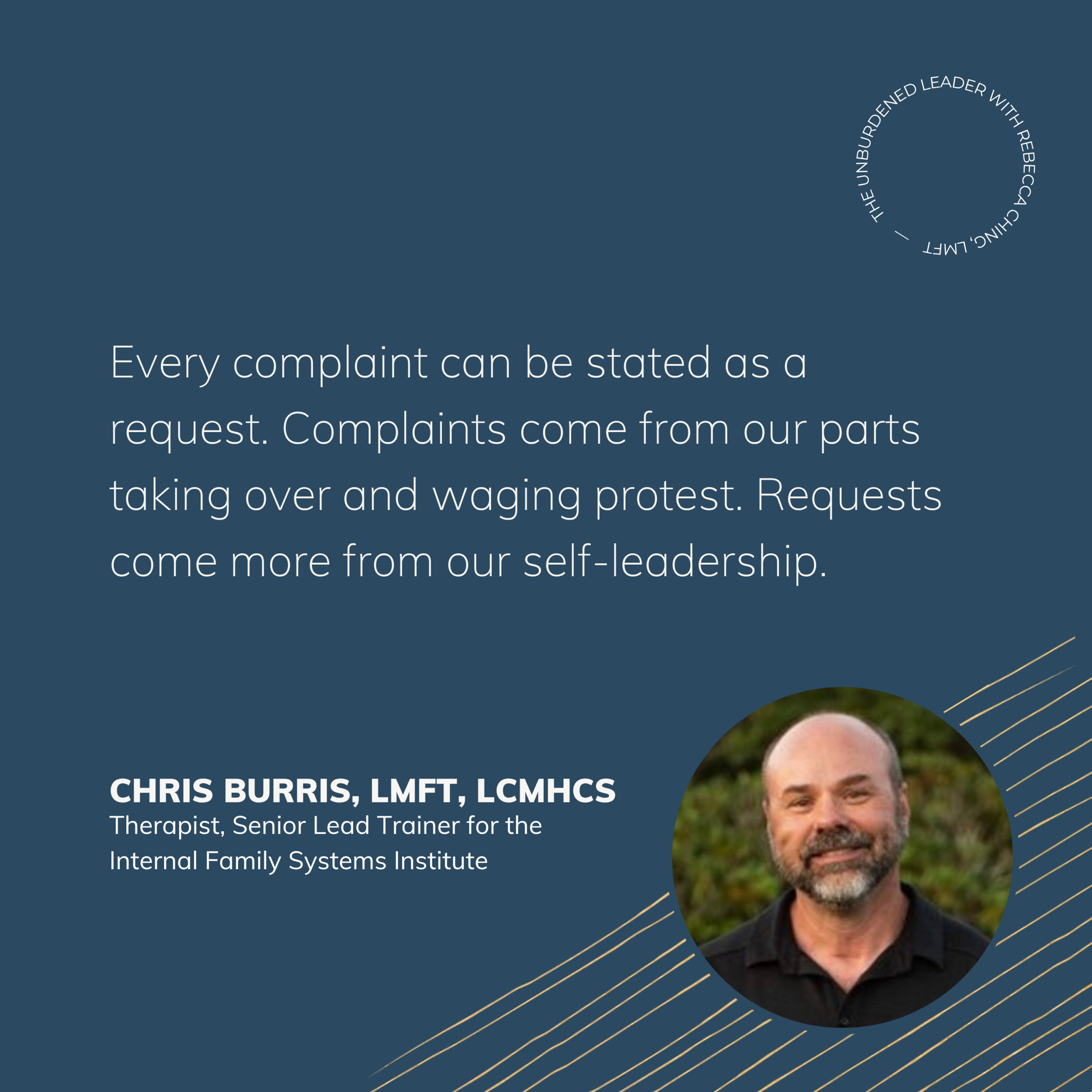
“Every complaint can be stated as a request.”
“Parts beget parts.”
“A good team leader tracks the dynamics.”
“Conflict often happens when people are having completely different conversations without realizing it.”
“I don’t have to fix people to acknowledge what they’re feeling.”
“Leadership is more of a marathon than a sprint.”
“Power gets abused when we deny that we have power.”
“The relationship really matters.”
“Sometimes the relationship becomes stronger because of the conflict.”
“The goal isn’t perfection. The goal is returning to relationship.”
“Knowing your body really well is part of staying grounded.”
“Self-care helps me stay in the relational zone.”
“If I’m in a guilt and shame spiral, it’s hard to return to relationship.”
“We don’t always get to pick the teams we’re on.”
“What kind of support actually feels supportive to this person?”
“Every presenting problem has an intention.”
“Am I charged with leading this?”
“Not all activism actually has impact.”
Conversation Highlights
02:00 — Growing Up Hypervigilant
Chris reflects on growing up on a farm in rural North Carolina with a chronically ill mother and how hypervigilance shaped his nervous system, relationships, and leadership.
04:00 — Dyslexia, Pattern Recognition & Reading Groups
How being dyslexic taught Chris to deeply observe people, group dynamics, emotional tone, and relational patterns instead of relying on books or written information.
06:00 — What It Means to Be “Porous”
Chris explains his sensitivity to emotional environments and how he learned to distinguish between what belongs to him and what belongs to others.
08:00 — Empathy Without Over-Responsibility
Why acknowledging someone’s emotions does not mean fixing, rescuing, or carrying them.
09:00 — Trauma, Isolation & Not Leaving People Alone
Chris shares why emotional isolation intensifies suffering and how simple acts of attunement can reduce shame and disconnection.
11:00 — Boundaries, Self-Care & Leadership
The practices Chris relies on to stay grounded while leading emotionally intense groups and trainings.
13:00 — Returning to the Relational Zone
How Chris tracks when he leaves a connected, relational state and shifts into self-protection or defensiveness.
15:00 — Why IFS Changed Everything
What Internal Family Systems offered Chris that other modalities did not, especially around identity, self-leadership, and inner relationships.
17:00 — Harsh Inner Critics & Leadership
Why self-criticism impacts collaboration, leadership, and emotional resilience more than most people realize.
19:00 — Accountability Through an IFS Lens
How leaders can balance compassion and accountability without abandoning either.
21:00 — “Every Complaint Is a Request”
Chris reframes conflict as information about unmet needs, unclear norms, or requests for different ways of relating.
23:00 — Group Dynamics & Storming
Why conflict escalates when group norms are unclear and how skilled facilitators create psychological safety.
25:00 — Staying Grounded During Conflict
Chris shares the somatic and relational practices that help him regulate himself when tensions rise in groups.
27:00 — Repair, Reconnection & Relationship
What meaningful repair actually requires and why some conflicts strengthen relationships over time.
30:00 — The Right Use of Power
Why denying power often leads to misusing it and how leaders can hold authority with more awareness and compassion.
32:00 — Critical Mass of Self Energy
How healing harsh inner criticism helps leaders recover more quickly from mistakes, shame spirals, and relational ruptures.
34:00 — Mean Girls, Exclusion & Young Protective Parts
Chris explores how exclusion dynamics often come from younger protective strategies around belonging and safety.
36:00 — Courageous Conversations & Norm Setting
Why effective leaders clarify purpose, name group dynamics, and create explicit norms for how teams will work together.
38:00 — What Makes a Strong Team Leader
The importance of tracking emotional escalation, clarifying conversations, and maintaining focus on group intention.
41:00 — Leadership, Roles & Responsibility
Chris reflects on the difference between leading yourself versus being charged with leading others.
43:00 — Staying Grounded in Uncertain Times
How Chris navigates heaviness, uncertainty, and overwhelm by focusing on meaningful, generative work and reciprocal relationships.
45:00 — Quick Fire Questions
Chris shares the books, music, ideas, and people currently shaping his thinking and leadership.
Closing Reflection
This conversation is a masterclass in relational leadership.
Not performative leadership.
Not perfectionistic leadership.
Not leadership built on control.
But leadership rooted in:
👉 self-awareness
👉 nervous system regulation
👉 repair
👉 clarity
👉 compassion
👉 accountability
👉 relationship
Chris reminds us that leadership is not about never becoming activated.
It’s about noticing when we leave connection…
and learning how to return.
To ourselves.
To our values.
To the people we lead.
To the relationships that matter.
And maybe one of the most important questions we can ask ourselves in moments of conflict or overwhelm is simply:
👉 “What’s happening here?”
Not as judgment.
Not as criticism.
But as curiosity.
Because curiosity creates the possibility for repair, clarity, and connection again.
💬 Reflection Prompt
What helps you return to yourself when you notice you’ve left the relational zone?







Comments +