

Most of us know about the “fight, flight, freeze” responses to trauma. But there is another concept that has been steadily gaining awareness over the last several years, in large part due to pop psychology on social media: Fawning.
You might have heard it described as akin to extreme people-pleasing, over-accommodating, over-functioning, and fundamentally a problem in the person doing the fawning. But as my guest today illuminates for us, it’s not a personal failing, or even always a conscious choice.
It is human nature to prioritize safety and connection, and fawning is a means of keeping ourselves safe. But when fawning runs the show, self-leadership diminishes and quietly drifts toward conflict-avoiding, blurred boundaries, and self-abandonment.
Waking up to your fawning response takes courage. You will meet resistance from some as you shift the dynamics of your relationships. But it also unlocks deeper intimacy, more honest connection, and the joy that comes from trusting yourself and letting others meet the real you.
This conversation invites you to consider where and with whom you fawn, and how you might want to respond in the future. Fawning has a real purpose when safety is on the line, but the more we are aware of it, the more we can be intentional about how we show up in our relationships.
Ingrid Clayton is a licensed clinical psychologist with a master’s degree in transpersonal psychology and a Ph.D. in clinical psychology. In her private practice in Los Angeles she supports individuals in healing trauma, reclaiming agency, and reconnecting to their authentic selves.
She is a regular contributor to Psychology Today, and her work has been featured in Oprah Daily, The New York Times, Women’s Health, Forbes, 10% Happier with Dan Harris, Girls Gotta Eat, and NPR’s On Point with Meghna Chakrabarti. Ingrid’s latest book, Fawning: Why the Need to Please Makes Us Lose Ourselves and How to Find Our Way Back, explores the often-overlooked fawn response to trauma.
Listen to the full episode to hear:
- Why fawning shows up as an unconscious response to ongoing relational trauma
- How understanding fawning helped Ingrid understand and heal from her own complex trauma
- How our culture demands and reinforces fawning for women and marginalized people
- The often very real bind of choosing safety over self and the feedback loop it creates
- Accessible practices to build a sense of internal safety and self-trust
- How chronic fawning and self-abandonment contribute to burnout
Learn more about Ingrid Clayton, PhD:
- Website
- Instagram: @ingridclaytonphd
- Facebook: @ingridclaytonphd
- YouTube: @ingridclaytonphd
- Unfawning on Substack
- Fawning: Why the Need to Please Makes Us Lose Ourselves–and How to Find Our Way Back
- Believing Me: Healing from Narcissistic Abuse and Complex Trauma
Learn more about Rebecca:
- rebeccaching.com
- Work With Rebecca
- The Unburdened Leader on Substack
- Sign up for the weekly Unburdened Leader Email
Resources:
- What Is the Fawning Trauma Response? | Psychology Today
- Peter Levine
- The Greatest Showman Cast – This Is Me
- The Traitors
Favorite Moments
“Fawning is not a personality—it’s a trauma response.”
“Connection becomes protection.”
“No one is choosing to appease someone harming them—your body chose it in a nanosecond.”
“It’s not a ‘you problem.’ It’s a nervous system response to a relational environment.”
“I loved myself enough to survive.”
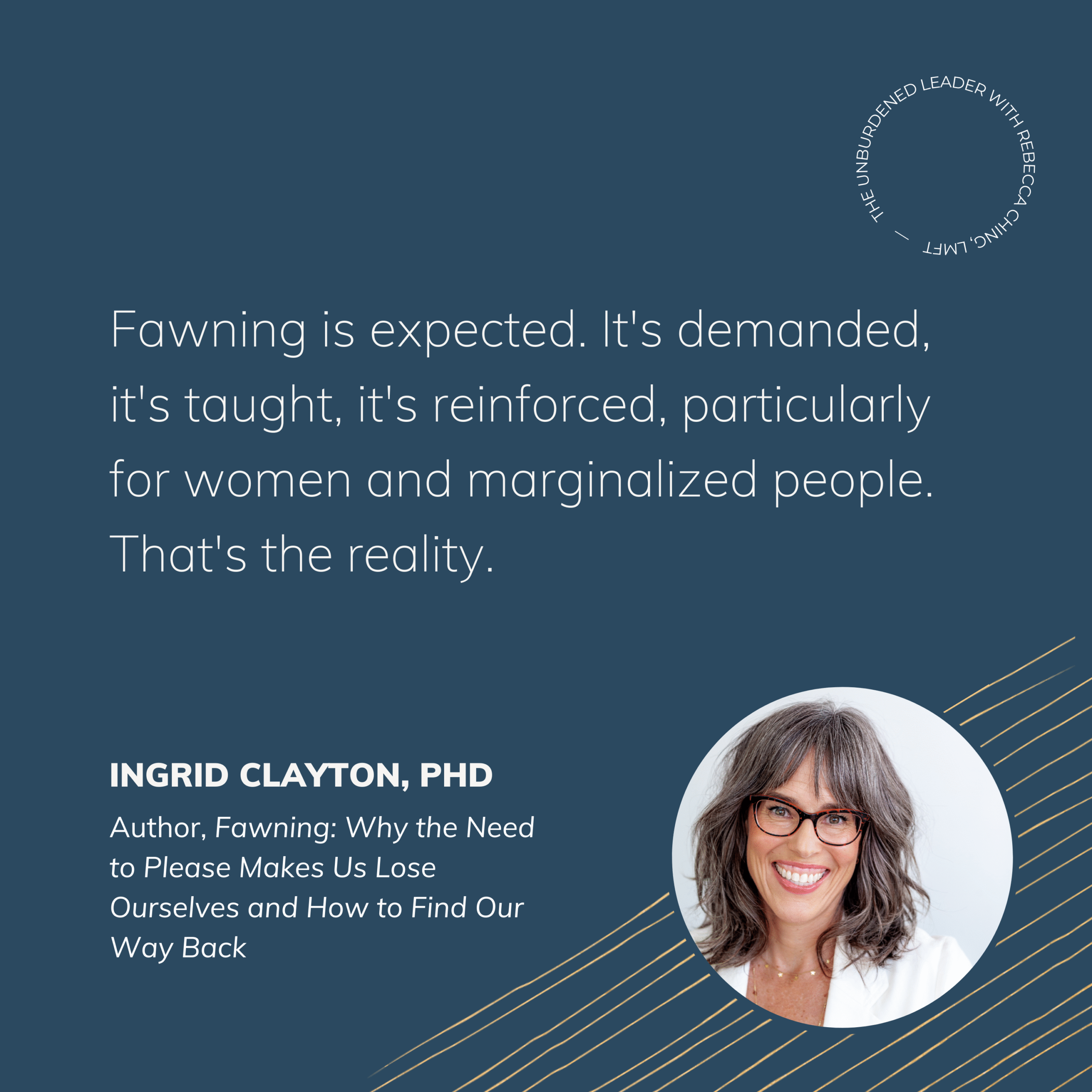
“Fawning is expected. It’s taught. It’s reinforced.”
“There is a real consequence for not fawning.”
“The body has to choose safety over self.”
“I can only exist if I’m helping.”
“What does this environment need me to be?”
“Shape-shifting is self-abandonment in real time.”
“You’re not broken—you adapted.”
“Healing doesn’t feel like a victory lap. It feels confusing, raw, and uncomfortable.”
“Don’t you deserve to know the difference between danger and discomfort?”
“We are not meant to live in survival mode 24/7.”
“I am here.”
Conversation Highlights
02:00 — What Fawning Actually Is (Beyond “People Pleasing”)
Dr. Clayton defines fawning as a trauma response—not a personality trait—and explains how it develops when fight, flight, or freeze aren’t safe options.
06:00 — Why Fawning Is Often Misunderstood
How social media and traditional psychology reduce fawning to “people pleasing,” missing its roots in complex trauma and survival.
10:00 — The Nervous System, Not a Choice
Why fawning happens automatically—and why shame has no place in understanding it.
15:00 — From Codependency to Context
How reframing fawning removes blame and instead highlights the relational environments that shaped it.
20:00 — Naming Trauma (Even When It’s Invisible)
Why relational trauma is hard to recognize—and how many people struggle to validate their own experiences.
25:00 — The Moment That Changed Everything
Dr. Clayton shares how safety (after her stepfather’s death) allowed her to finally see her own trauma clearly.
30:00 — “Connection Is Protection”
A powerful lens: fawning as a strategy to stay safe by staying close to the source of harm.
35:00 — Fawning in Real Time (and Why It Doesn’t Guarantee Safety)
Exploring how the body responds under threat—and why no response guarantees protection.
40:00 — The Double Bind: Safety vs Self
Why the body often chooses external safety over self-expression—and how this creates long-term self-abandonment.
45:00 — Speaking Up Isn’t Always Safe
A deeply important conversation about why “just speak up” advice can be harmful—and how systems reinforce silence.
50:00 — How Fawning Gets Rewarded
Why fawning often leads to success, praise, and leadership roles—while quietly disconnecting us from ourselves.
55:00 — The “Shape-Shifter” Pattern
What it looks like to adapt to every environment—and how that erodes authenticity and self-trust.
1:00:00 — Burnout and Identity Loss
How chronic fawning contributes to burnout, exhaustion, and feeling like you don’t know who you are.
1:05:00 — Losing (and Rebuilding) Self-Trust
Why trauma disrupts our ability to trust ourselves—and how healing requires slowly reconnecting inward.
1:10:00 — Healing Isn’t What You Think It Is
Why healing feels uncomfortable, confusing, and even “wrong”—and why that’s actually progress.
1:15:00 — Trauma Responses Explained Clearly
Breaking down what a trauma response actually is—and how it gets wired into long-term patterns.
1:20:00 — Navigating Today’s Overwhelming World
Practical ways to stay grounded, resourced, and present without burning out.
1:25:00 — Redefining Leadership
Leadership as embodiment, humanity, and self-awareness—not hierarchy or performance.
Closing Reflection
This conversation shifts something fundamental:
👉 It moves us from “What’s wrong with me?”
👉 to “What did my body learn to do to survive?”
It also challenges a deeply ingrained belief:
That healing should feel good, empowering, or clear.
Instead, it often feels:
- uncomfortable
- disorienting
- even painful
And that doesn’t mean you’re doing it wrong.
It means you’re getting closer to yourself.
💬 Reflection Prompt
Where in your life might your body be choosing safety over self—and what would it look like to gently start choosing both?








Comments +