
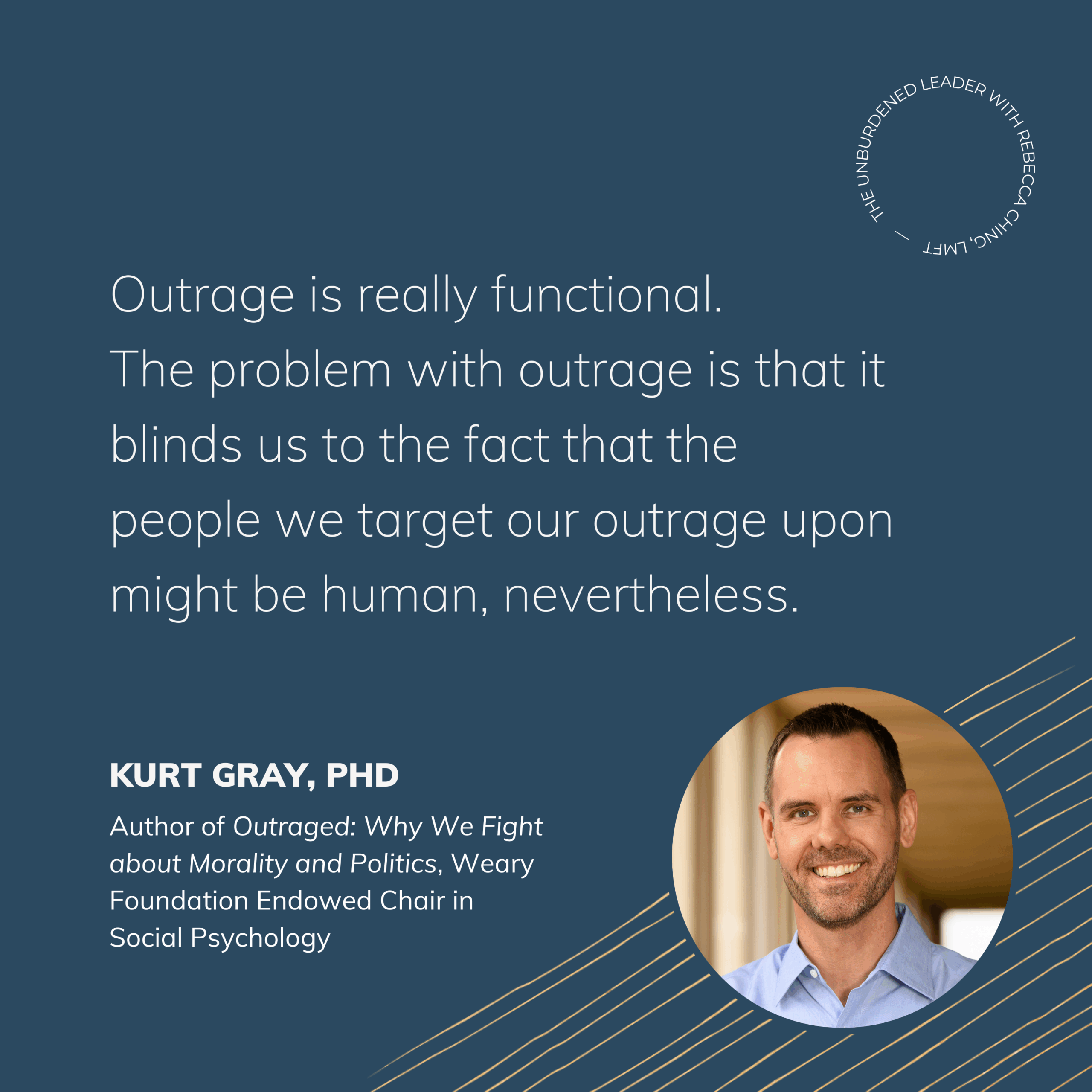

How do we stay awake and aware without constantly being outraged? Or, perhaps even worse, normalizing what should be utterly unacceptable?
Staying human is hard in this environment. So many leaders are trying to hold onto their boundaries and values against pressure to act contrary to them, to stay compassionate and curious when so many forces benefit from and encourage our outrage.
Anger, rage, and outrage are powerful and can be useful emotions. But when we live from a perpetual state of outrage, we lose access to the self-leadership and adaptive skills that help us lead well, and eventually it takes us out.
Today’s guest is here to help us understand what outrage really is, why it’s so potent right now, how it becomes weaponized, and how we can use it without losing ourselves.
Kurt Gray is a social psychologist who studies our moral minds and how best to bridge political divides. Gray received his PhD from Harvard University, and now directs the Deepest Beliefs Lab at The Ohio State University. He also leads the Center for the Science of Moral Understanding, which explores new ways to reduce polarization, and is a Field Builder in the New Pluralists, which seeks to build a more pluralistic America.
Gray’s work on morality, politics, religion, creativity, and AI has been widely discussed in the media, including the New York Times, the Economist, Scientific American, Wired, and Hidden Brain. He is the co-author of the book The Mind Club: Who Thinks, What Feels and Why it Matters, and the author of Outraged: Why We Fight about Morality and Politics.
Listen to the full episode to hear:
- How Kurt’s childhood experiences with his stepmother’s conservative, evangelical family have informed his thinking about how we can connect despite differences
- How our human wiring for threat detection causes “harm creep,” even while many of us are safer than ever
- How our outrage is connected to our perceptions of our risk and vulnerability
- How our moral imagination helps us maintain our empathy and humanity without losing sight of our values and boundaries
- Why we need to learn to recognize destruction narratives and how they’re being used to sow division
- Why leading with facts and statistics fails in moral and political arguments and how we can more effectively begin to bridge the gaps
- Why we need to leave room for uncertainty and humility in our convictions
Learn more about Kurt Gray, PhD:
- Website
- Connect on LinkedIn
- Moral Understanding Newsletter
- Outraged: Why We Fight About Morality and Politics and How to Find Common Ground
- The Mind Club: Who Thinks, What Feels, and Why it Matters
Learn more about Rebecca:
- rebeccaching.com
- Work With Rebecca
- The Unburdened Leader on Substack
- Sign up for the weekly Unburdened Leader Email
Resources:
- Atlas of the Heart: Mapping Meaningful Connection and the Language of Human Experience, Brené Brown
- Rage Becomes Her: The Power of Women’s Anger, Soraya Chemaly
- EP 96: Rage to Action: The Leading Power of Women’s Anger with Soraya Chemaly
- Brené Brown on the State of Leadership in America Today | On with Kara Swisher
- EP 52: Charlie Gilkey: Leading With What Matters Most
- Daryl Davis
- Saja Boys – “Your Idol”
- Stranger Things
- Bad Thoughts
- Ordinary People Change the World Series, Brad Meltzer and Christopher Eliopoulos
Favorite Moments
“Most people are not trying to destroy the world. They’re trying to protect themselves, their families, and the people they love.”
“We don’t disagree as much as we think we do — but when we do disagree, it’s often because we’re making different assumptions about who is vulnerable and how to protect them.”
“You cannot persuade someone if they don’t feel heard.”
“The destruction narrative says the other side wants to burn it all down. The protection narrative says they’re trying to prevent harm in the way that makes sense to them.”
“Facts matter. But stories are how humans make sense of the world.”
“I try to sit at 99% certainty instead of 100%. That 1% makes all the difference.”
“The inhuman are still human, for the most part.”
“Outrage can be useful fuel — but we can’t let it cost us our own moral compass.”
Conversation Highlights
02:00 — Growing Up Between Love and Difference
Kurt reflects on how being welcomed and loved by his stepmom’s large conservative evangelical family shaped his understanding of morality, politics, and human complexity.
06:00 — Why Kindness Complicated the Narrative
Even when Kurt deeply disagreed with his family’s beliefs, he couldn’t dismiss them as evil or stupid — because he knew firsthand their love and care were real.
10:00 — Harm Creep and Assumptions of Vulnerability
Kurt explains how our minds are wired to scan for threat, and how that can expand our definitions of harm in ways that fuel moral conflict and political outrage.
16:00 — Why Outrage Feels So Moral
Rebecca and Kurt unpack how outrage emerges when we think others are blocking our ability to protect ourselves, our loved ones, or our communities from harm.
22:00 — Moral Imagination and Seeing the Human
Kurt explores what it means to practice moral imagination: understanding how people come to hold harmful beliefs without excusing the harm those beliefs can cause.
29:00 — The Darryl Davis Example
They discuss Darryl Davis’s work with KKK members as an example of extraordinary moral imagination — and the immense emotional labor involved in trying to humanize the “other side.”
36:00 — Destruction Narratives vs. Protection Narratives
Kurt introduces one of the book’s core concepts: most people are not acting from a desire to destroy, but from a desire to protect — even when their methods or beliefs differ sharply from ours.
42:00 — Why Facts Alone Don’t Change Minds
Kurt explains why statistics so often fail to persuade and why stories and lived experience are usually the bridge to connection, understanding, and eventual change.
49:00 — The Uber Driver Story
Kurt shares a powerful story about a ride to the airport with a self-described Christian nationalist, and how a boundary-filled but respectful conversation shifted the tone and opened the door to mutual understanding.
56:00 — Outrage as Moral Fuel
Rebecca and Kurt explore how outrage can be functional and mobilizing, but also how easily it can slide into self-righteousness, blame, and the loss of our own values.
1:01:00 — 99% Certainty
Kurt offers one of the episode’s most practical leadership ideas: holding our convictions strongly while leaving just enough room to learn, revise, and stay humble.
1:07:00 — What Gives Him Hope
Kurt shares why everyday human interactions — not social media — are what give him the most hope about our ability to reconnect, understand one another, and build a better future.
Kurt reminded me that outrage can sharpen our sense of what matters, but it can also narrow our vision if we let it. Protecting our outrage doesn’t mean feeding it endlessly — it means using it wisely, without losing our capacity for curiosity, humility, and connection.
This conversation is for every leader who is trying to stay awake to injustice without surrendering to cynicism, who wants to hold strong convictions without hardening into certainty, and who is learning that understanding someone is not the same thing as agreeing with them.
Let’s Keep the Conversation Going
Where in your life are you being invited to move from a destruction narrative to a protection narrative — and what shifts when you do?
I’d love to hear from you. 💛







Comments +