

Every day, we’re flooded with information–headlines, opinions, advice, noise. And beneath that deluge of input, we carry stories that tell us how we stay safe and what asking questions will cost us.
Certainty too often feels like safety. So we rush to respond before we understand and defend before we discern. We don’t pause to reflect or to question the loudest voices in the room–proverbial or otherwise.
But certainty at the expense of discernment can damage our connections to each other and to ourselves.
Leadership that builds connection and trust for the long term requires us to cultivate the courage to ask questions and follow the answers, even when it’s uncomfortable. When we catch an old story running the show and stay curious instead of certain, we can metabolize what’s driving reactivity and protection.
It’s how we stay open, grounded, and self-led in a world that rewards reactivity.
My guest in this conversation refers to this practice as faithful skepticism: asking hard questions without abandoning hope. When I read his moving essay, “Groomed by the Church: How The Clash Saved My Soul,” I knew I had to invite him here to discuss the importance of refining our discernment and cultivating skepticism as a vital tool for effective leadership. And how music serves as a powerful trailhead–both as a cultural lightning rod and as a catalyst for self-discovery.
David Adey is a multimedia artist based in San Diego, CA. His work has been exhibited at The Museum of Contemporary Art San Diego, Orange County Museum of Art, Crystal Bridges Museum, Minneapolis Institute of Art, Frist Center for The Visual Arts, Oceanside Museum of Art, Cranbrook Art Museum, and venues nationally and internationally. His work has been featured in publications including Art in America, LA Weekly, The Huffington Post, Wired Magazine, Thisiscolossal, and PBS. He received his MFA in sculpture from Cranbrook Academy of Art. Adey is a professor of art and design at Point Loma Nazarene University.
Listen to the full episode to hear:
- How an outing to see a Black Sabbath cover band inspired David’s essay
- How the parallels of the Satanic Panic of his youth and our current cultural moment took the essay from journal entry to published work
- Why David believes in the power of being offensive with a purpose
- How the church’s narrow focus on spiritual dangers came at a cost to real life safety
- How David’s teenaged experiences inform how he now leads his students and parents his children
- The impact of his mother’s support when he both wanted to reject his musical loves and then reconnect with them
- Why faithful skepticism is a powerful antidote for certainty and cynicism
Learn more about David Adey:
- Website
- Instagram: @davidadey.studio
Learn more about Rebecca:
- rebeccaching.com
- Work With Rebecca
- The Unburdened Leader on Substack
- Sign up for the weekly Unburdened Leader Email
Resources:
- Groomed By the Church: How The Clash Saved My Soul | The Rumpus
- Satanic panic
- Jeff Koons
- The Anxious Generation: How the Great Rewiring of Childhood Is Causing an Epidemic of Mental Illness, Jonathan Haidt
- North Country, Gillian Welch and David Rawlings
- Loot
- Star Wars
- Richard Rohr
- Thich Nhat Hanh
Favorite Moments
“Being offended with a purpose can be really valuable. Often, when I experience offense, it probably says more about me than it does about whatever is offending me.”
“It was easier to fear an invisible, mythical being than to recognize the devil among us.”
“My mom allowed me to make an enormous mistake.”
“A skeptic embraces doubt and asks lots of questions, where the cynic has already made up their mind.”
“It’s not only skepticism about what I see out in the world — it’s also being skeptical about my own opinions.”
“I’m much more process-driven than outcomes-driven.”
“If looking at art and making art doesn’t help us understand our everyday lives and relationships, then it’s useless.”
“The certainty of the hopeless cynic is perhaps the most destructive form of surrender — and resisting it may be the most constructive form of rebellion.”
Conversation Highlights
02:00 — How the Essay Began
David shares how a Black Sabbath tribute concert, attended in the raw days after his father’s death, unexpectedly became the spark for writing Groomed by the Church: How the Clash Saved My Soul.
06:00 — When Fear Loses Its Teeth
What once symbolized danger and spiritual threat suddenly felt harmless, joyful, and strangely beautiful. David reflects on how that night became a kind of integration moment.
10:00 — The Devil We Missed
Rebecca and David explore one of the essay’s central tensions: how communities can become so fixated on imagined threats that they miss actual harm happening in plain sight.
15:00 — The Cost of Certainty
David reflects on how a narrow, fear-based spiritual culture focused on all the wrong things — and how sincerity without skepticism can still create real damage.
20:00 — Burning the Records
David revisits the moment he destroyed his music collection to fit in spiritually, and the quiet grief and loss that followed almost immediately.
25:00 — The Quiet Wisdom of His Mother
Rebecca and David talk about the surprising wisdom in his mother’s response — questioning him, then letting him make the mistake, and later helping him rebuild what he had lost.
31:00 — Music as Freedom, Tether, and Formation
David shares how music, especially The Clash, became more than escape. It became a way to stay grounded in himself, emotionally alive, and resistant to systems of fear and control.
37:00 — Teaching with Curiosity Instead of Certainty
David explains how his childhood experiences shaped the way he teaches art today: process over perfection, experimentation over compliance, and failure as meaningful data.
43:00 — Leadership, Art, and the Beginner’s Mind
Rebecca and David explore how contemporary art can train us to sit in discomfort, question first impressions, and cultivate curiosity rather than rigid certainty.
49:00 — Faithful Skepticism as a Way of Life
David reflects on the essay’s closing line and what it means to remain a “faithful skeptic” — someone who resists both blind certainty and hopeless cynicism.
55:00 — Leadership That Makes Room
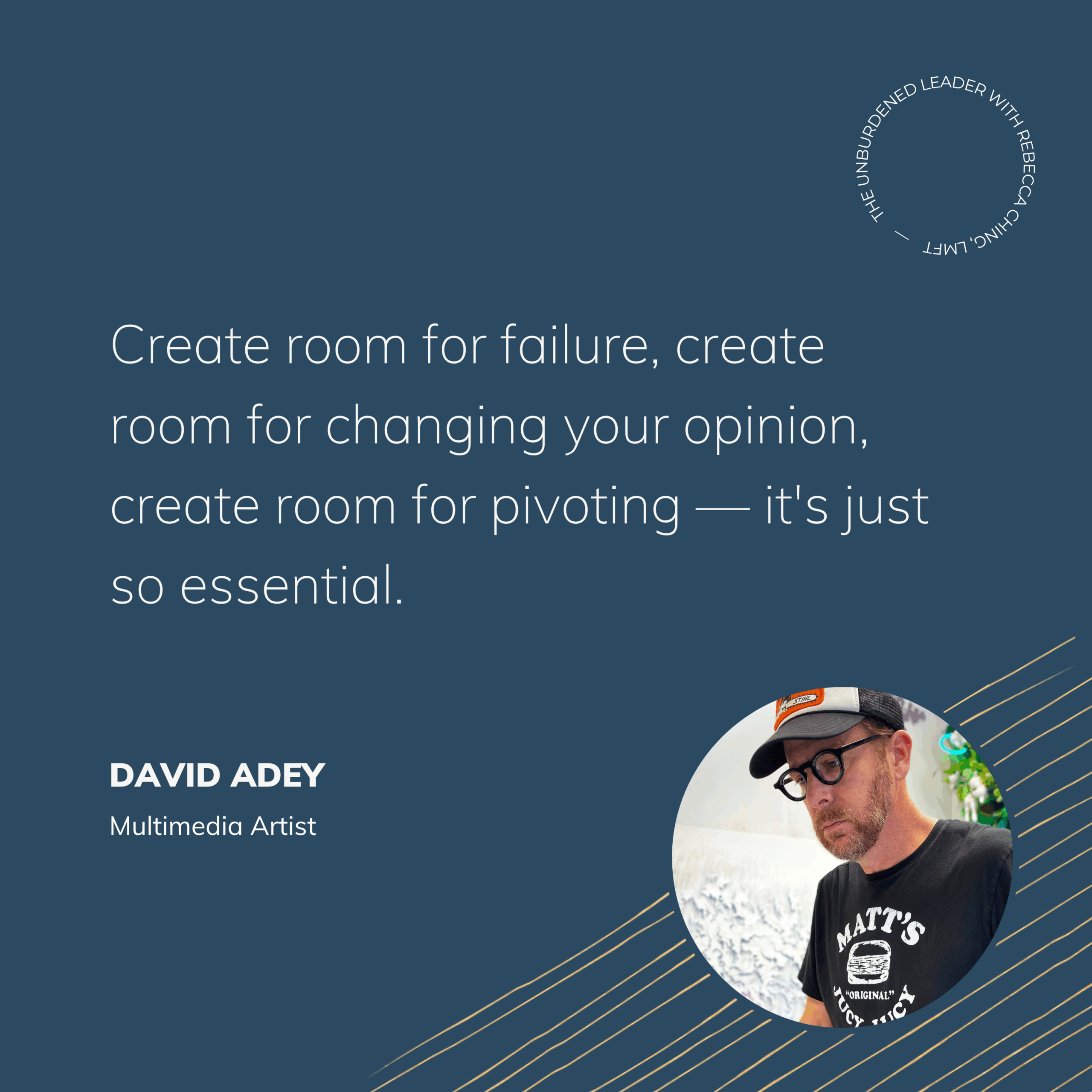
The conversation closes with David’s definition of leadership: making room for failure, change, experimentation, and growth — in ourselves and in others.
David reminded me that certainty can feel powerful, but it often keeps us small. Skepticism — especially when rooted in humility, curiosity, and faith — can be a far more courageous path.
This conversation is for every leader who has ever felt the pull of belonging, the cost of conformity, or the quiet rebellion of learning to trust their own voice again.
Let’s Keep the Conversation Going
Where in your life are you being invited to trade certainty for curiosity and what might become possible if you did?
I’d love to hear from you. 💛




Comments +