

What does it mean to be good?
It’s a little word that carries a lot of weight for many of us. Be a good girl. Be a good friend. Be a good leader. Do good.
Good can sound like praise, but become a cage of expectations and shoulds, a performance that chips away at our authenticity. Good is no longer something we are, but is how others see us. It leads us to people please and keep the peace at all costs. And that’s especially true for women.
All too often, when women are in leadership, their goodness is measured by how they make others feel–good, comfortable, understood. All of that matters. But when the measure of leadership becomes how comfortable other people feel around us, we lose something essential.
We perform and manage emotions instead of building trust and respect. We seek to be liked and to fit in at the cost of real integrity and effectiveness. And likability is oh-so fleeting.
Respect, integrity, and true belonging take time and discomfort to build, but they last.
My guest today has written beautifully and bravely about the cost of being good, the truth of belonging, and the courage it takes to lead ourselves and others through discomfort.
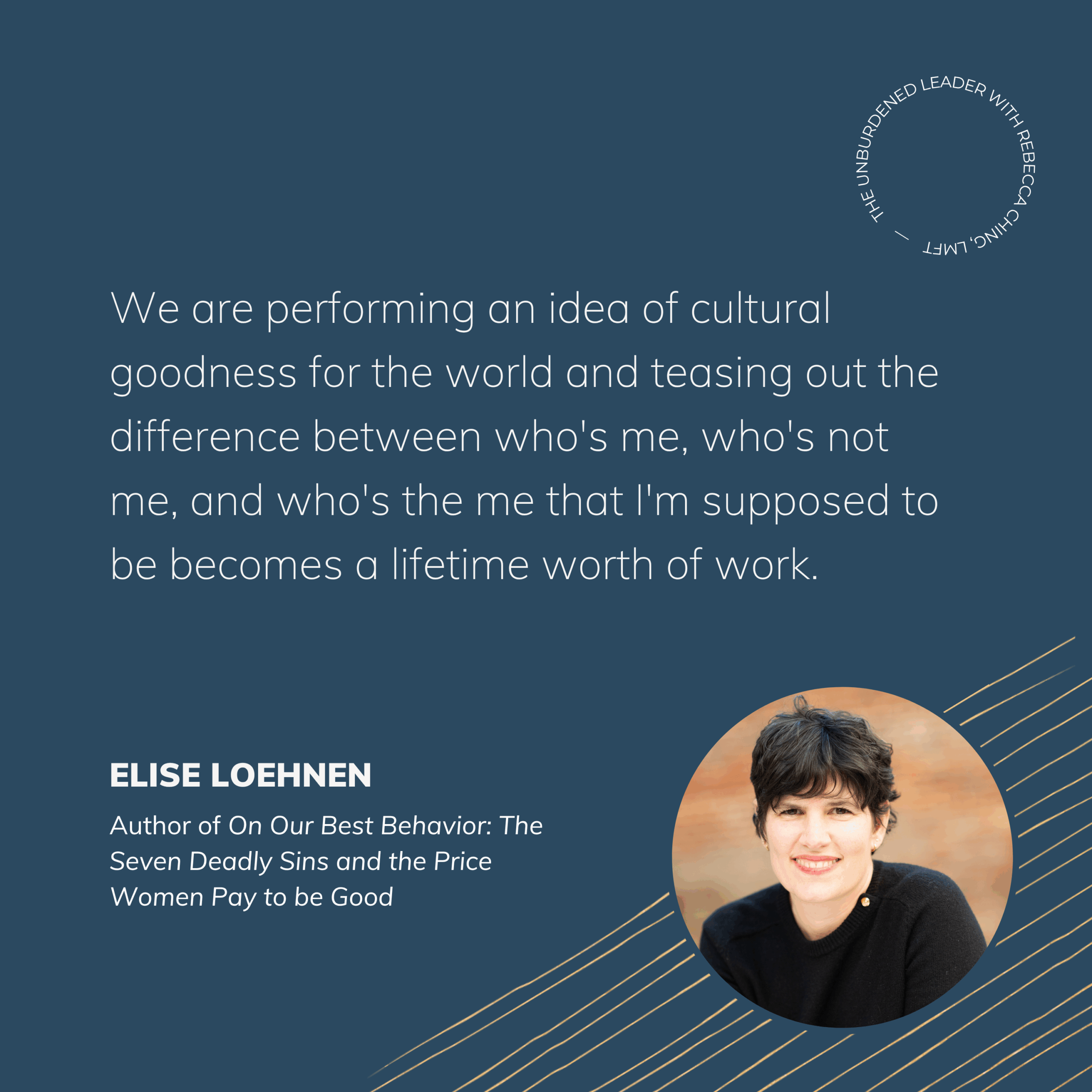
Elise Loehnen is the New York Times bestselling author of On Our Best Behavior: The Seven Deadly Sins and the Price Women Pay to be Good and the host of the podcast, Pulling the Thread, where she interviews cultural luminaries about the big questions of today, including people like Joy Harjo, John and Julie Gottman, Dr. Gabor Maté, and Esther Perel. In addition to On Our Best Behavior, she is the author of a corresponding workbook—Choosing Wholeness Over Goodness—with coach Courtney Smith (July 2025), and the co-author of True & False Magic, with legendary psychiatrist Phil Stutz. Elise lives in Los Angeles with her husband, Rob, and their sons, Max and Sam.
Listen to the full episode to hear:
- How Elise traced the cultural roots of the “good woman” back to early Christianity and the many additions, erasures, and mistranslations of Biblical stories
- Why we need to pay attention to our envy and how it shows up in relation to other women
- How envy, pride, and greed fuel each other and the ways we stay small and tear other women down
- How social media has heightened the risk of reputational damage and changed how women work and lead, for better and worse
- Why we latch onto ideas of goodness and purity more deeply in times of greater uncertainty
- How current narratives about the “natural” order are ahistorical manipulations that limit what we believe is possible
Learn more about Elise Loehnen:
- Website
- Pulling the Thread on Substack
- Instagram: @eliseloehnen
- On Our Best Behavior: The Price Women Pay to Be Good
- Choosing Wholeness Over Goodness: A Process for Reclaiming Your Full Self
- True and False Magic: A Tools Workbook
Learn more about Rebecca:
- rebeccaching.com
- Work With Rebecca
- The Unburdened Leader on Substack
- Sign up for the weekly Unburdened Leader Email
Resources:
- Braving the Wilderness: The Quest for True Belonging and the Courage to Stand Alone, Brené Brown
- EP 123: Befriending Your Nervous System: Building Capacity for Regulation with Deb Dana
- The Intrinsic Order that Emerges from Within Chaos (Elinor Dickson, PhD)
- Dancing in the Flames: The Dark Goddess in the Transformation of Consciousness, Elinor Dickson and Marion Woodman
- EP 88: Right-Use-of-Power: Navigating Leadership Dynamics with Dr. Cedar Barstow
- EP 125: Power, Regulation, and Leadership: Connecting to Your Personal Power with Dr. Amanda Aguilera
- The Reprioritization of Relationship (Lori Gottlieb)
- Maybe You Should Talk To Someone: A Therapist, HER Therapist, and Our Lives Revealed, Lori Gottlieb
- Lessons from Hollywood’s Most Powerful Woman—And How They Can Help You (with Donna Langley) | Aspire with Emma Grede
- Answer to Job, Carl Jung
- Aion: Researches Into the Phenomenology of the Self, Carl Jung
- The Science of Magic: How the Mind Weaves the Fabric of Reality, Dean Radin PhD
- Mistakes Were Made (but Not By Me): Why We Justify Foolish Beliefs, Bad Decisions, and Hurtful Acts, Carol Tavris and Elliot Aronson
- Sigur Rós – YouTube
- Jónsi – YouTube
- Love Island
- The Gilded Age
- Maiden
- Stutz
Favorite Moments
“Goodness, as I’m writing about it, is not your innate goodness — it’s an external performance shaped by culture.”
“The question becomes: who is defining goodness… and why are we giving them that power?”
“A ‘good woman’ needs no rest, has no wants, takes up no space — and never gets upset about it.”
“We’ve inherited ideas about goodness that are actually cultural stories — not truths about who we are.”
“We need to be hard on systems and soft on people — but we’ve learned to do the opposite.”
“Envy isn’t something to suppress — it’s a signal pointing to what we want.”
“The instinct isn’t ‘I’m envious’ — it’s ‘this person needs to go away because they’re making me uncomfortable.’”
“Your envy is a mirror — it’s showing you a part of yourself you haven’t allowed yet.”
“There’s a difference between not liking someone… and being activated by them.”
“We think we’re self-aware — but most of us are being driven by our unconscious.”
“May we judge ourselves lightly, and each other not at all.”
Conversation Highlights
02:00 — What Is “Goodness,” Really?
Elise unpacks the difference between innate goodness and the culturally imposed version of “being good” — and why that distinction is so difficult to untangle.
06:00 — The Cultural Script of a “Good Woman”
They explore the invisible rulebook many women inherit: be selfless, small, agreeable, and tireless — and how these expectations quietly shape identity and leadership.
11:00 — Where These Ideas Come From
Elise traces how concepts like the seven deadly sins became embedded in culture — not as neutral truths, but as historical constructs that still influence modern behavior.
18:00 — Faith, Culture, and Misinterpretation
A powerful reflection on how spiritual ideas have been shaped, translated, and sometimes distorted over time — and how to reconnect with what feels true.
24:00 — Living Authentically in a World That Rewards Performance
Rebecca and Elise discuss the tension between knowing your truth and navigating systems that still reward conformity and “goodness.”
30:00 — Power, Responsibility, and Systems
Elise reframes power as something we already have — and emphasizes personal responsibility as the starting point for change.
36:00 — Envy as Data (Not a Flaw)
One of the most impactful moments: envy as a diagnostic tool. Instead of pushing it away, it becomes a map toward desire, purpose, and unlived potential.
42:00 — The Shadow Work of Envy
They break down how envy often shows up as judgment or irritation — and how pausing in that moment reveals what we truly want.
48:00 — Envy vs. Jealousy
Elise clarifies the difference: jealousy involves a third party, while envy is intimate — a direct reflection between you and another person.
52:00 — Women, Power, and the Myth of Scarcity
A nuanced conversation about how cultural conditioning fuels competition among women — and how scarcity thinking keeps cycles of comparison alive.
58:00 — Leadership, Feedback, and the Pressure of “Goodness”
Elise reflects on her leadership journey and how the pressure to be “good” can dilute clarity, feedback, and effectiveness.
01:05:00 — The Rise of Purity Culture & “Tradwife” Aesthetics
They unpack the modern resurgence of purity narratives — and how they’re rooted in nostalgia, fear, and a desire for certainty.
01:12:00 — Reclaiming Personal Power
A return to agency: recognizing how much power we actually hold — and how cultural narratives can disconnect us from it.
01:18:00 — Holding Polarities Without Collapsing
Elise shares her closing reflection on embracing complexity — resisting extremes and learning to live in nuance.
Elise reminds us that the work isn’t about becoming “good” — it’s about becoming whole.
That means questioning what we’ve inherited, noticing what we perform, and slowly reclaiming the parts of ourselves we’ve been taught to suppress.
This conversation is for anyone who’s ever felt the tension between who they are… and who they’ve been taught to be.
💌 Let’s Keep the Conversation Going
Where in your life are you performing “goodness”… instead of expressing your full self?
And what might change if you gave yourself permission to question it?
Reply and tell me — or drop a comment on High Stakes: An Unburdened Leader Dispatch.
I want to hear from you. 💛








Comments +