

We live in an age where truth twists into confusion, opinion drowns out data, and it’s increasingly difficult to figure out whose expertise we can trust.
Where did our mistrust in expertise come from? Its roots stretch back to deliberate misinformation campaigns beginning in the 1950s spread by the likes of Big Tobacco, Big Oil, and conservative church movements. Then social media poured gasoline on the fire, accelerating the spread of misinformation and making sowing division highly profitable.
Misinformation campaigns take advantage of our brains’ natural tendency to protect the familiar and mistrust outgroups. And they capitalize on the very real betrayals people have experienced at the hands of corporations, governments, schools, and healthcare systems.
Our challenge now isn’t just knowing the facts, it’s interrogating our own beliefs, asking where our evidence comes from, and resisting the pull of certainty. As leaders, we need to discern who we give our attention to, practice critical thinking, resist manufactured controversy, and platform voices committed to both truth and connection.
Today’s guest is a neuroscientist and author of Why Brains Need Friends, who works to make science accessible, relational, and rooted in respect. He doesn’t focus on winning arguments or shaming people into submission. He focuses on bridging divides, building trust, and reminding us that our brains–and our lives–are wired for connection.
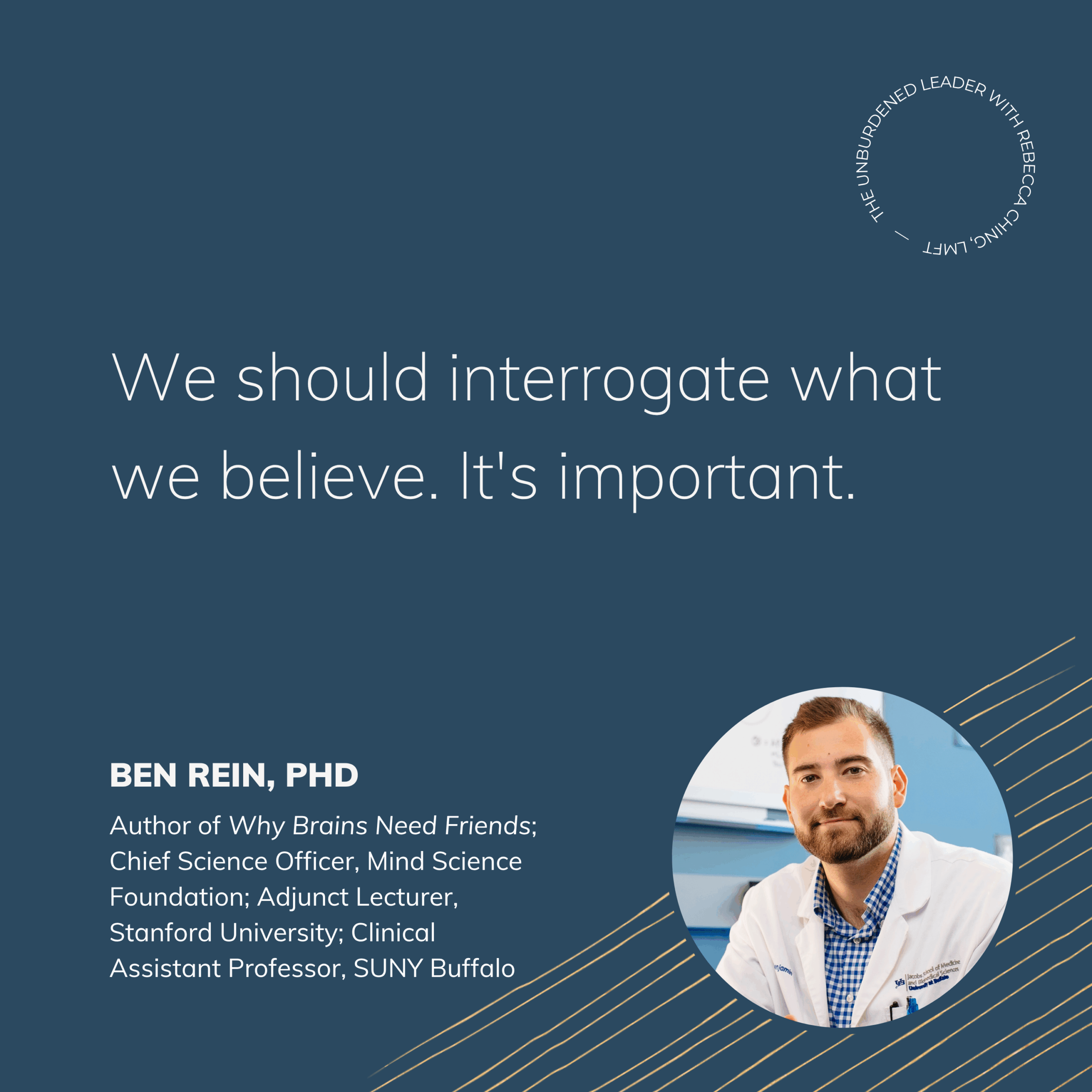
Ben Rein, PhD is an award-winning neuroscientist and science communicator. He serves as the Chief Science Officer of the Mind Science Foundation, an Adjunct Lecturer at Stanford University, and a Clinical Assistant Professor at SUNY Buffalo. He has published over 20 peer-reviewed papers on the neuroscience of social behavior, and is the author of Why Brains Need Friends: The Neuroscience of Social Connection. In addition, Rein educates an audience of more than 1 million social media followers and has been featured on outlets including Entertainment Tonight, Good Morning America and StarTalk with Neil DeGrasse Tyson. He has received awards for his science communication from the National Academies of Science, Engineering, and Medicine, the Society for Neuroscience, and elsewhere.
Listen to the full episode to hear:
- How an especially vivid nightmare redirected Ben’s path to neuroscience
- Why the division and isolation of modern life is so bad for our brains and overall health
- How engaging with strangers isn’t as awkward as we often think it is, and why we should do it more
- How small social interactions build our sense of belonging, community, and wellbeing
- Why we need to recognize and then override our gut reactions to those we perceive as belonging to outgroups
- How social media sound bites vastly oversimplify the complex and unknown systems in our brains
- Why Ben’s primary mission to to help people understand the value of looking to data and evidence rather than personalities and experiences
- Why we all have to get better at fact-checking and questioning why we’re ready to believe something
Learn more about Dr. Ben Rein:
Learn more about Rebecca:
- rebeccaching.com
- Work With Rebecca
- The Unburdened Leader on Substack
- Sign up for the weekly Unburdened Leader Email
Resources:
- Golden Holocaust: Origins of the Cigarette Catastrophe and the Case for Abolition, Robert N Proctor
- “Assessing ExxonMobil’s climate change communications (1977–2014),” Geoffrey Supran and Naomi Oreskes, 2017 Environmental Research Letters 12 084019
- The Creationists: From Scientific Creationism to Intelligent Design, Ronald L. Numbers
- “Misinformation and Its Correction Continued Influence and Successful Debiasing,” Stephan Lewandowsky et al., 2012 Psychological Science in the Public Interest, 13(3)
- The Logic of Scientific Discovery, Karl Popper
- SciSpace
- Sapiens: A Brief History of Humankind, Yuval Noah Harari
- Dune, Frank Herbert
- The Poisoner’s Handbook: Murder and the Birth of Forensic Medicine in Jazz Age New York, Deborah Blum
- Tory Lanez – Gangland x Fargentina 4EVR (feat. Wolfgang Peterson & Kai)
- Hard Knocks: Training Camp
- Courage the Cowardly Dog
Favorite Moments
“Division is the enemy of brain health.”
“Our brains have been wired through evolution to reward us for being around others.”
“We are a social species, not a solitary species.”
“Interactions often exceed our expectations.”
“The more someone claims to know, the less they probably know.”
“We should interrogate what we believe.”
“Everybody has something to gain from sharing information online.”
“Leaders can be anywhere, and can be anything.”
“The leadership stick can bounce around.”
“Passing on information has always felt to me like maybe the most valuable use of my time.”
Conversation Highlights
02:00 — The Dream That Changed Everything
Ben shares the terrifying dream he had in college about a demon controlling his life, and how waking from it clarified that he needed to stop playing small and fully pursue neuroscience.
07:00 — Becoming a Parent While Managing Narcolepsy
Rebecca and Ben talk about the realities of his narcolepsy, his fears about sleep deprivation, and how he and his wife are already thinking about support, planning, and what they’ll need as new parents.
11:00 — Why Division Hurts the Brain
Ben explains that humans evolved for connection, not isolation, and that division and disconnection don’t just feel bad emotionally, they actively undermine brain health and overall wellbeing.
16:00 — Why Talking to Strangers Matters More Than We Think
They explore how even small moments of human connection can regulate us, improve mood, and create a sense of belonging, and why our assumptions about social awkwardness are often wrong.
20:00 — We’re Wired for Connection… and Also for Division
Ben unpacks the evolutionary roots of ingroups and outgroups, how empathy changes depending on who we see as “us” versus “them,” and why those ancient patterns no longer serve modern life.
27:00 — What Leaders Can Learn from Tribal Psychology
The conversation turns to leadership, camaraderie, and the power of shared purpose, while also naming the risks of slipping into tribalism or “power over” dynamics.
32:00 — Dopamine, Serotonin, and the Problem with Oversimplified Neuroscience
Ben breaks down why social-media soundbites about brain chemicals are often misleading, and why real neuroscience is far more nuanced than “dopamine is the happy chemical.”
39:00 — The Serotonin Myth and What We Still Don’t Know
He explains the common misunderstanding around serotonin and depression, why SSRIs can still help even if “low serotonin” is not the whole story, and why brain science resists simple answers.
44:00 — Science Communication in the Age of Misinformation
Rebecca and Ben discuss what it means to communicate science responsibly, how bad information spreads faster than truth, and why it’s so important to return to evidence instead of personality or persuasion.
49:00 — “Interrogate What You Believe”
One of the strongest themes of the episode: Ben invites listeners to pause, examine what they believe, ask where those beliefs came from, and check them against actual evidence.
54:00 — Leadership as Guidance, Not Just Title
Ben shares how his definition of leadership has evolved from seeing it as a fixed role to understanding it as something fluid, relational, and often passed between people in real time.
56:00 — Mentorship as a Form of Leadership
For Ben, leadership today looks a lot like teaching, mentoring, and helping the next generation find their way, especially in science and education.
Ben reminds us that our brains are built for connection, shaped by evidence, and deeply affected by the quality of the relationships and information we allow in.
This conversation is for every leader trying to think clearly, stay human, and resist the pull of fear, division, and oversimplified answers.
💌 Let’s Keep the Conversation Going
Where in your life do you notice division, isolation, or misinformation impacting how you think, connect, or lead?
And what would it look like to get a little more curious, connected, and evidence-based?
I want to hear from you. 💛







Comments +