

There is a well-known cognitive phenomenon that we are all susceptible to, and even more so when we’re stressed. And we’re all at least a little stressed and overwhelmed right now.
The illusory truth effect catches us when we repeatedly hear statements and begin to assume they are true through repetition and familiarity. Things feel true, even if they couldn’t be further from it. Research has shown that sheer repetition can even override facts when we know better.
Naming–systems, feelings, what we’re witnessing, what’s missing, what’s wrong–is a powerful antidote to the illusory truth effect. Naming forces us to slow down. It interrupts the repetition. We can’t meaningfully talk about integrity, values, courage, or innovation if we refuse to look directly at what is.
My guest today reminds us that we can’t disrupt what we can’t name. And we can’t heal what stays vague.
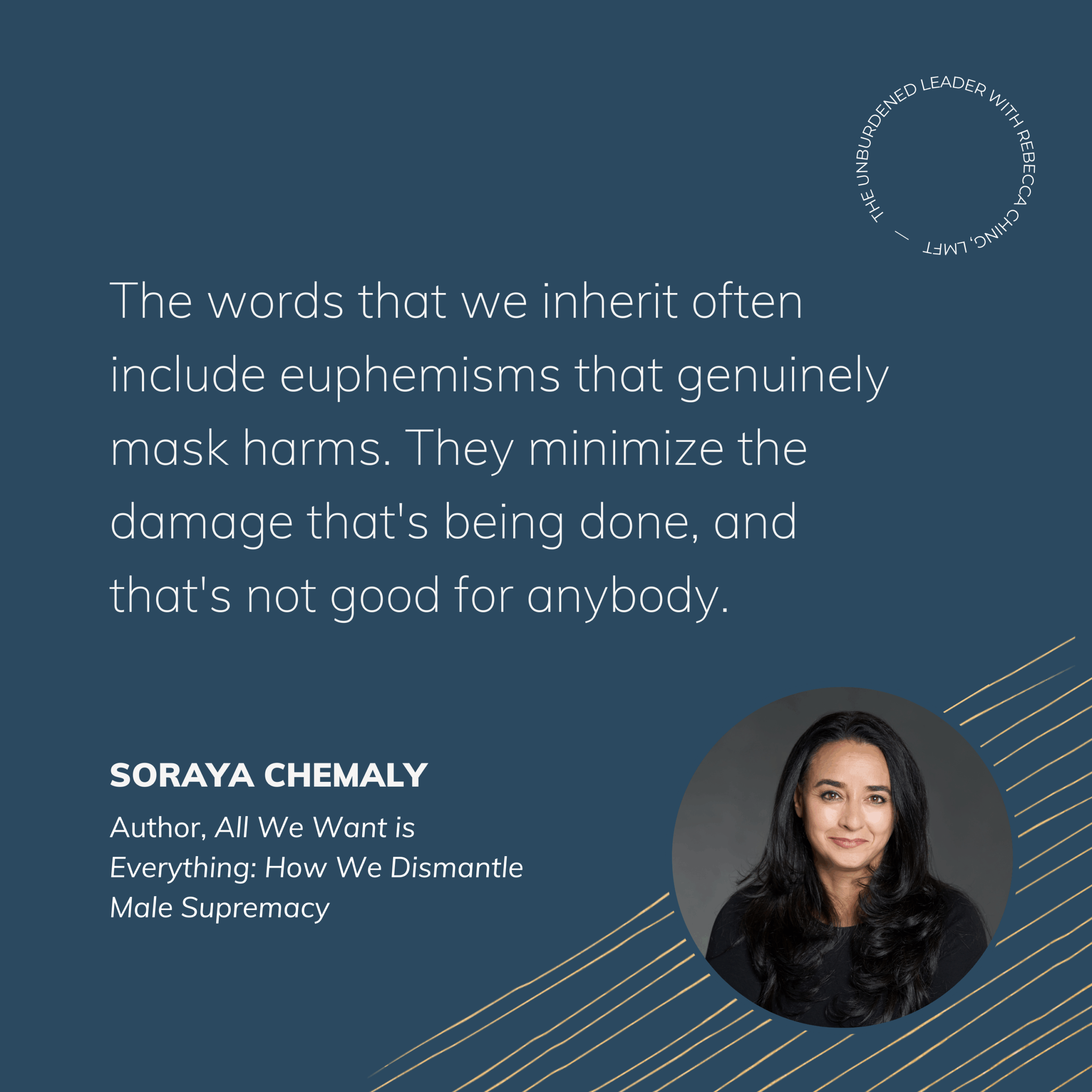
Soraya Chemaly is an award-winning author and activist. As a cultural critic, she writes and speaks frequently about gender norms, social justice, free speech, sexualized violence, politics, and technology. The former Executive Director of The Representation Project and Director and co-founder of the Women’s Media Center Speech Project, she has long been committed to expanding women’s civic and political participation.
Her most recent book, All We Want is Everything: How We Dismantle Male Supremacy, has been called “a potent rallying cry for a beleaguered feminist movement.” In it, she challenges dearly held beliefs about gender and equality today, drawing clear lines between the dynamics of intimate inequality and global anti-feminist, anti-democratic backlash and machofascism.
Content warning: Discussion of details of the video footage leading up to Renee Good’s murder, less-detailed discussion of sexual and gender-based violence and harassment
Listen to the full episode to hear:
- Why we need to name systems clearly and specifically in order to challenge them
- How male supremacy encompasses concepts of sexism, misogyny, and patriarchy and frames them as part of a larger hierarchical system
- How we’re witnessing DARVO play out at scale in our government and media, as well as in personal interactions
- How deepfakes use the pervasive threat of sexual violence against women to dehumanize and enforce subjugation
- How women play roles in passing on and enforcing male supremacy
- How “the boy crisis” reinforces norms of masculinity at the expense of girls and women
- Why big tent politics that asks everyone but cis, straight men to give up fundamental rights cannot be a yardstick of success
Learn more about Soraya Chemaly:
- Website
- Instagram: @sorayachemaly
- All We Want is Everything: How We Dismantle Male Supremacy
- Subscribe to Unmanned
Learn more about Rebecca:
- rebeccaching.com
- Work With Rebecca
- The Unburdened Leader on Substack
- Sign up for the weekly Unburdened Leader Email
Resources:
- Dechêne, A., Stahl, C., Hansen, J., & Wänke, M.. The Truth About the Truth: A Meta-Analytic Review of the Truth Effect. Personality and Social Psychology Review, 14(2), 238-257
- Pennycook, G., Cannon, T. D., & Rand, D. G. (2018). Prior exposure increases perceived accuracy of fake news. Journal of Experimental Psychology: General, 147(12), 1865–1880
- Thinking, Fast and Slow, Daniel Kahneman
- Fazio, L. K., Brashier, N. M., Payne, B. K., & Marsh, E. J. (2015). Knowledge does not protect against illusory truth. Journal of Experimental Psychology: General, 144(5), 993–1002.
- EP 96: Rage to Action: The Leading Power of Women’s Anger with Soraya Chemaly
- EP 117: Rethinking Resilience: Moving from Bouncing Back to Relational Resilience with Soraya Chemaly
- Jennifer Joy Freyd, PhD.
- What is DARVO ? | Jennifer Joy Freyd, PhD.
- 11. Boy Crisis Asides and the Invisible People and Power Living in Them | Unmanned
- Afterlives, Abdulrazak Gurnah
- Radiohead – Creep
- I’d Love to Change the World – Ten Years After
- Don’t Let’s Go to the Dogs Tonight
- Blondie
- The Beginning Comes After the End: Notes on a World of Change, Rebecca Solnit
Favorite Moments
“Male supremacy isn’t about individual men being bad people—it’s a system that shapes everything.”
“When we soften language, we erase harm.”
“Cynicism and euphemisms don’t make us safer—they make us more vulnerable.”
“Good men don’t need cookies.”
“Good men need bad men to exist—otherwise the system would have to change.”
“We are trained to focus on individual interactions… when what we’re actually seeing is a pattern.”
“This is not just a tech story. It’s a gender-based violence story.”
“It’s not Grok. It’s not AI. It’s men.”
“Even now, we can do this to you—and no one will stop us.”
“Women are not hypersensitive to threat—we are trained to recognize it.”
“We are not waiting for change. We are the change.”
“That’s why we’re in backlash—because dismantling is already happening.”
Conversation Highlights
02:00 — Why Language Matters (and Why It Feels Uncomfortable)
Soraya unpacks why terms like “male supremacy” create resistance—and why avoiding them actually makes harm harder to address.
05:00 — Defining Male Supremacy Clearly
A grounded explanation of male supremacy as a system—not an attack on individual men—and how it shapes power, culture, and institutions.
10:00 — What Gets Lost When We Soften Language
How euphemisms erase harm, minimize violence, and ultimately make everyone less safe.
15:00 — Connecting the Dots: Patriarchy, Misogyny, White Supremacy
Soraya explains how male supremacy acts as the connective tissue across different systems of inequality.
20:00 — Moving Beyond “Good Men vs Bad Men”
Why focusing on individual identity misses the systemic issue—and how “not all men” conversations derail meaningful change.
25:00 — The Reality of Socialization (for Men and Women)
A powerful look at how masculinity is constructed—and why expectations like “protecting women” are both unrealistic and harmful.
30:00 — DARVO at Scale: From Personal to Political
Soraya connects interpersonal abuse patterns (deny, attack, reverse victim/offender) to how systems and governments operate.
35:00 — Media, Bias, and Narrative Framing
How coverage often avoids naming perpetrators and reframes gender-based violence as neutral or technical issues.
40:00 — Deepfakes, Power, and Public Space
Why AI-generated sexualized images are not just “tech issues”—but acts of domination, silencing, and control.
45:00 — The Invisible Cost of Being a Woman
A striking conversation about everyday safety calculations, financial costs, and emotional labor women carry.
50:00 — Early Conditioning Around Safety and Threat
Personal stories that illustrate how girls are taught to navigate risk—and how that shapes behavior for life.
55:00 — How Women Reinforce the System (Often Unconsciously)
Exploring internalized beliefs, victim-blaming, and the role women play in maintaining or challenging systems.
1:00:00 — The “Boy Crisis” Conversation (and What’s Missing)
Soraya breaks down why common narratives around masculinity can unintentionally reinforce patriarchal norms.
1:05:00 — Male Supremacy in Progressive Spaces
Why even feminist or progressive environments can replicate harmful structures without intentional awareness.
1:10:00 — Redefining Leadership
A shift from top-down power to recognizing leadership in communities, care work, and everyday impact.
1:15:00 — Why Backlash Means Change Is Happening
A hopeful reframe: resistance and backlash are signs that systems are already being dismantled.
This conversation is not an easy one—but it’s an important one.
It challenges how we think about power, language, safety, and leadership—not just in systems, but in our everyday lives.
If you’ve ever felt the tension between wanting to name something clearly and not wanting to “go too far”—this episode will resonate.
It’s also a powerful reminder that discomfort isn’t a signal to stop—it’s often a signal that we’re getting closer to the truth.
💬 Reflection Prompt
What is one idea or belief from this conversation that made you uncomfortable—and what might that discomfort be trying to show you?













Comments +